
Hisae Ikenaga
Anatomies of Use, in Fragments
2026
For her first solo exhibition in Belgium, Hisae Ikenaga presents a selection of works that explore our relation to the objects and forms that surround us, questioning the systems that shape them. In Anatomies of Use, familiar forms are transformed, appropriated, and reconfigured, destabilizing their function, status, and meaning.
This interview with Houda Ben Azzouz follows a conversation that took place a few days before the opening, while moving through the exhibition space at KIOSK. Between unpacked crates, unfinished installations, and objects still being positioned, Hisae Ikenaga walked us through the works, stopping, reflecting, explaining.
What follows traces this movement through the exhibition, where each work opens onto process, relation, and perception. The text takes the form of a continuous flow. It moves alongside the works and invites the reader to navigate the exhibition through its fragments, connections, and how it shifts our perspective.
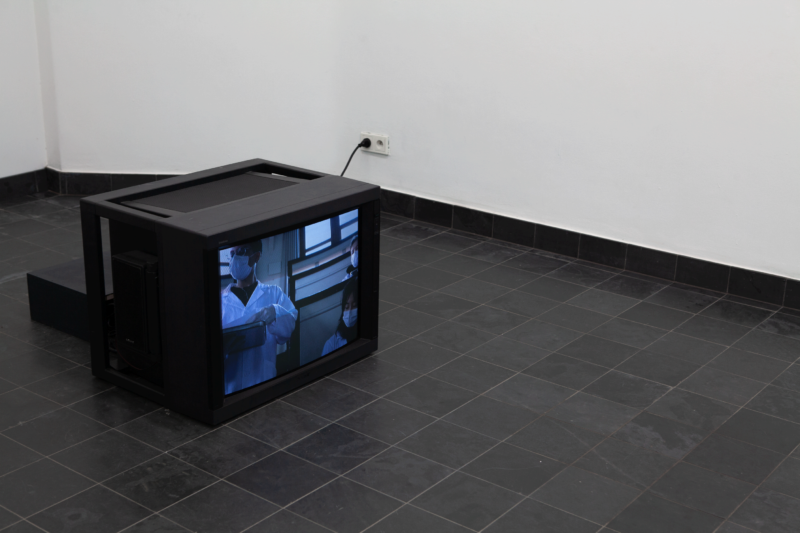
Soft Dissection
From the moment you enter the space, material takes center stage.
You don’t encounter it as an object, but through gesture. Manipulation. Contact. The space feels familiar, yet something holds your attention. You can’t quite look away from these almost ritualistic movements.
In the film, material is pressed, shaped, observed, drawn. It moves between touch and vision, between action and observation, forming a sequence that leads toward an unknown result. Through repetition, these gestures begin to synchronize.
It is not yet an object. It is still something in formation.
“This space used to be a hospital, with theatres where bodies were once shown, dissected, observed. That history stayed with me. I wanted to mix everything, to create forms that relate to the body without ever fully becoming it. They are made of porcelain, coloured or pigmented, and they look like organs, but not really. There is always a hesitation.
At the same time, I was thinking about drawing. Before photography, in archaeology or in botany, people would learn by observing and copying. Archaeologists told me that this way of registering things allowed you to really understand what you were looking at. Now, you take a picture and you feel like you have everything, but you don’t really see anymore.
So I wanted to create a situation where this kind of attention could happen again. A kind of class, but also a space of production. In the film, nobody speaks. You only hear the gestures, the manipulation of the clay. People come, they do their own thing, they observe, they draw. It becomes a kind of ritual.
It’s also very spontaneous. We explain a little bit what we want, and then people just do what they already know how to do. They are not actors. They repeat gestures they are familiar with. So it becomes something in between, not really fiction, not really documentary.”
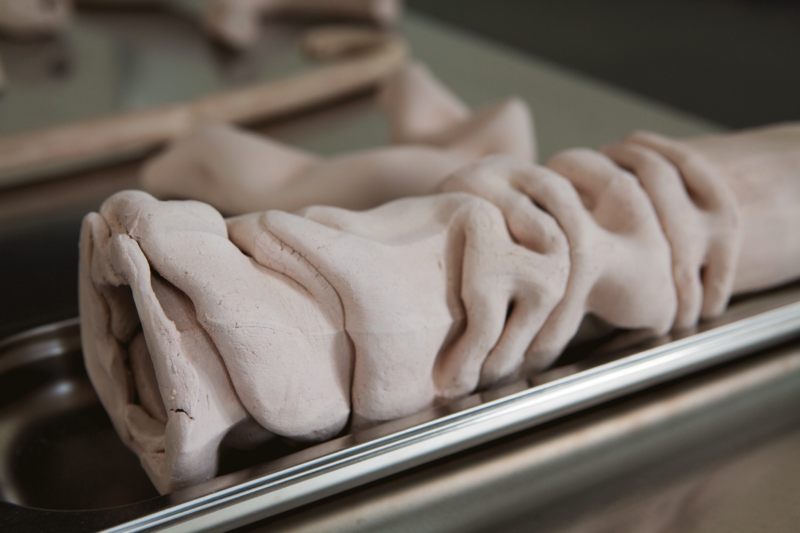
Restes Morcelés
Then you move forward, and you encounter this material again. These shapes reappear.
But now they are there, in front of you.
Spread across the tables surrounding the video, both a continuation and a closing step, the forms appear familiar. They resemble something organic, industrial, domestic, yet remain impossible to identify.
You recognize them, but you cannot name them.
And this hesitation stays with you.
“Working with clay changed a lot for me. It’s very physical. You have to manage humidity, pressure, timing. Every type of clay reacts differently. It’s something you understand with your hands more than with your head. I like that. It’s a bit like cooking, but also like playing. I try things, I experiment, I see what happens.
And things go wrong. They break, they collapse, they explode in the kiln. But the mistakes are not really mistakes. They are part of the process. That’s also what makes the craft not industrial. You can see that there is a human behind it.
Industrial production doesn’t allow error. Everything has to be identical. For me, that’s impossible. I will never produce something that looks the same. So I go in the opposite direction. I work fast, I keep the irregularities, I keep the breaks.
I’m interested in those shapes, in how they appear, and in how we recognize and associate them. You see something, and you think you know what it is, because it is close to you. The material, the form, the scale. But then something is off. It doesn’t function anymore.
That moment interests me. When you realize that what you see cannot be used. Your head tries to understand, and something doesn’t align. I like that confusion. It opens something.”
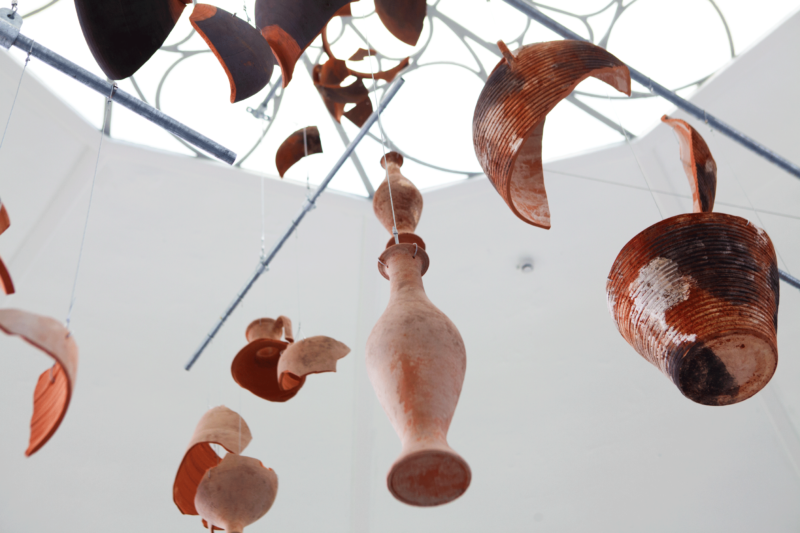
Hanging Archaeological Manufacturing
Above, something shifts.
The objects feel familiar. You recognize their form, or think you do. They suggest a function, but that function no longer holds. They are broken.
Fragments hang in space, suspended above your head. They look old. Almost archaeological.
But when you look closer, something doesn’t match. The inside is new. The break reveals the present. They remain out of reach, impossible to use.
Familiarity does not guarantee use.
At the same time, the installation changes your position. You start looking up. The architecture comes back into view.
Your gaze moves between the objects and the space.
“At the same time, I’m very interested in how objects are presented. In museums, for example, the way something is displayed tells you how to look at it. It tells you what is important. It guides your perception. But I also like to question that.
In archaeology, we often see objects that are broken. And somehow, when they are broken, they become more important. That is a bit absurd. I like to play with that. To create objects that feel real, but they are not.
I once made a fake archaeological site. People believed it. Even archaeologists came to see it. That’s interesting to me, this tension between what we think is true and what is constructed.
Because we never really have the full picture. What we see is always partial. Many objects were made of different materials, and some of those materials disappear over time. Leather, fabric… they’re gone. So, what remains is incomplete. And what we understand is always based on that incompleteness.
I like to imagine what would happen if, in the future, someone found these objects. They would probably not understand them at all. And maybe that’s fine. I like this idea of doing things that don’t fully make sense, but that open other ways of thinking.”
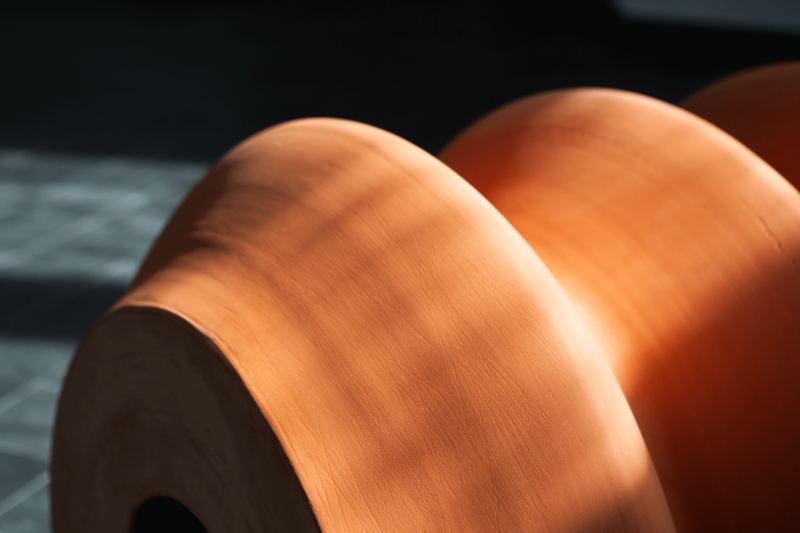
Industrial Ruin
Further in the space, the scale shifts, but the questions remain.
Large cylindrical forms stand in the room, immediately drawing your attention. You try to connect them to what you have just seen. They resemble containers, industrial elements, yet also recall more domestic forms.
They suggest function, but remain ambiguous.
Again, something doesn’t align.
They refer to a precise system, but without granting access to it.
They activate intuition, only to destabilize it.
“I often start from things that already exist. I keep the shape, but I change the material, or I cut it, or I alter it so that it becomes useless. And in that moment, something opens. You start to question not only the object, but also the way you relate to it.
I live in Luxembourg, where the steel industry has been present for centuries. I visited factories where you see metal melting, moving through rollers that shape it into beams. It’s very impressive.
What interested me was not the final object, but the tool that transforms it. So, I took these industrial rollers and reproduced them in ceramic.
But then something shifts. The roller becomes just a shape. It doesn’t function anymore. Originally, it is used to transform something very hard, like steel. Now it is made in a material that is fragile.
There is a contradiction there. You recognize the object, but you cannot use it. And again, your perception is disrupted.”
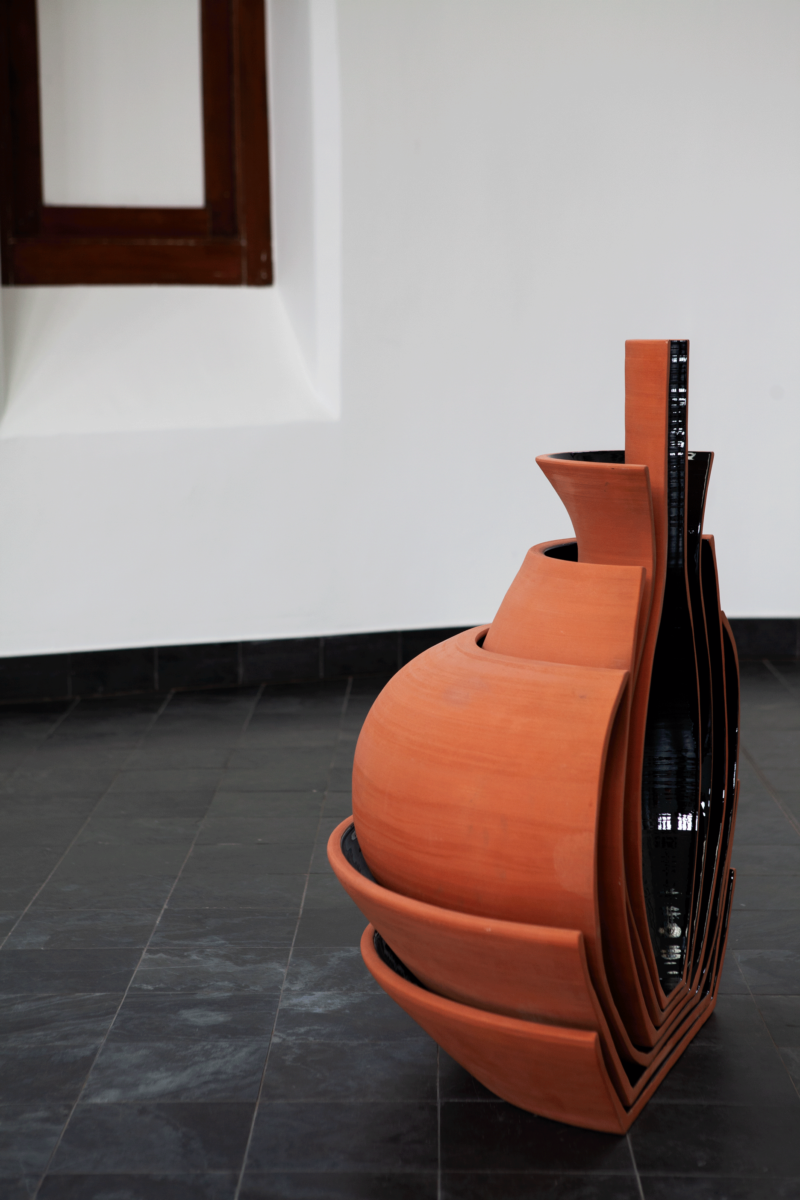
Black Artichoke II
At the end, the objects open.
The artichokes are cut. Split. Exposed.
Here, the interior becomes the most striking element. The glaze. The black surface. The irregular lines. Everything that was hidden becomes visible.
The symmetry expected from the outside dissolves.
What remains are the irregularities, the accidents, the traces of the hand.
“Sometimes, understanding comes from opening.
I like when you can see the traces of the hand, the lines left by the fingers. When you cut a piece, what was hidden becomes visible. The inside reveals something that the outside was concealing.
You see the asymmetry, the irregularity, the way it was made.
The glaze is inside rather than outside. What is usually hidden becomes visible. It’s a kind of reversal.
I’m interested in this gesture of cutting, not to explain the object, but to expose something that was already there. Not to complete it, but to show that something is always missing.
Maybe that’s also how I work. I don’t start with a fixed idea. Sometimes I don’t really think before I begin. I just start making, mixing things, and only afterwards I realize that they are connected.
It’s not a linear process. It’s more like a spiral. I come back to the same ideas, but from different angles.
I’m interested in techniques, in materials, in the reasons behind shapes. Every object has a history. Every form exists for a reason, whether it is technical, economic, or cultural.
And at the same time, I try to break with that. I take fragments, details, familiar elements, and put them together in a way that doesn’t fully make sense.
Because everything around us has a reason, even the smallest detail. There is a whole world behind the objects we use every day. We just don’t always take the time to look.
And maybe that’s what remains. Not the whole object, but fragments. Not a fixed meaning, but something that shifts.
I prefer to float. If I think too much, I wouldn’t do anything.”
Houda Ben Azzouz is a Brussels-based visual artist and researcher working across design, curating, printmaking & photography. Her practice explores how visual forms shape cultural narratives and how visual languages influence one another across cultures and histories. She is currently following the postgraduate Curatorial Studies at KASK & Conservatorium (2025–2026).
Images © Houda Ben Azzouz
