Miranda Pastor
If you can’t take a joke
2025
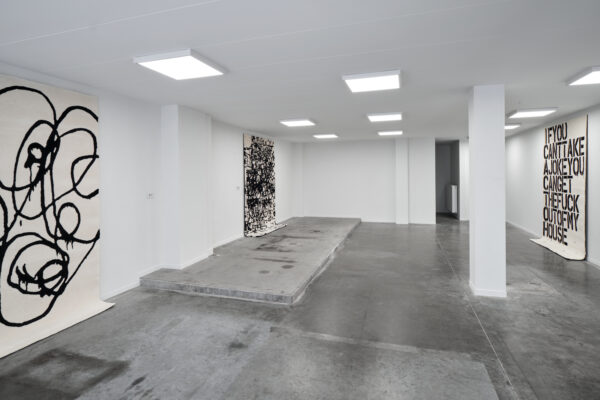
On a spring Sunday afternoon, Kortrijk is a quiet town where people go for a stroll with friends or family. Silence and tranquillity pervade the streets, where warmer temperatures still mingle with cool breezes. Halfway between the centre and the station, on one of the streets, is rhizome_, the non-profit art space of two passionate collectors, Monia and Marc. A large glass partition separates the street from the space, creating a different atmosphere with its low ceilings, immaculate walls, and Egon Van Herreweghe's brand new works.
100% WOOL is Van Herreweghe's new solo exhibition at rhizome_, presented in collaboration with KIOSK and curated by Simon Delobel. The artist, a long-time admirer of Christopher Wool's work, produced this concise selection of pieces after becoming intrigued by the history of one of them. In 1999, an American collector acquired the work Apocalypse Now (1988), but was forced to sell it two years later at the request of his partner. This painting, with large stencilled words enouncing “SELL THE HOUSE SELL THE CAR SELL THE KIDS”, was then auctioned at Christie's, increasing its value, but also leaving behind a home for which it was not suited.[1]
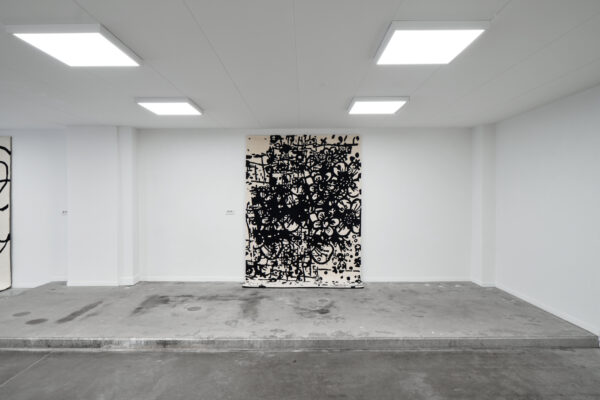
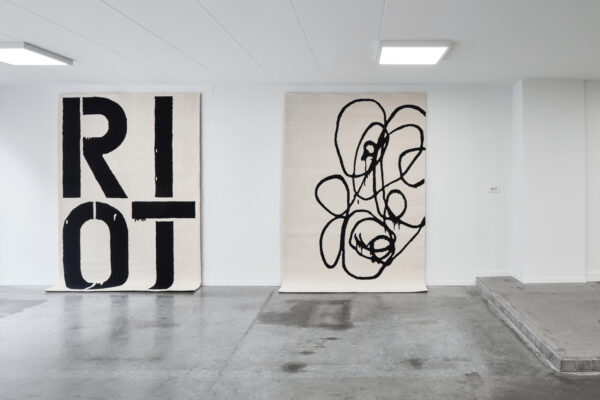
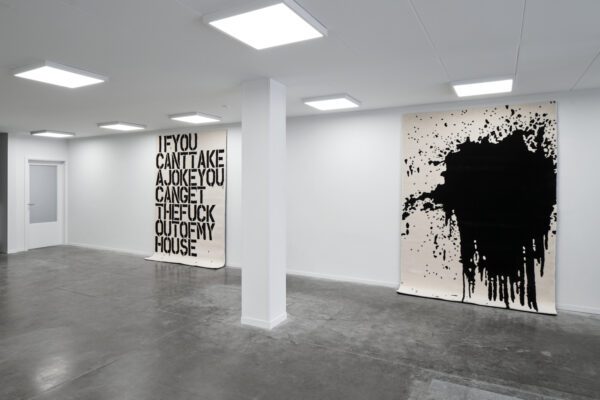
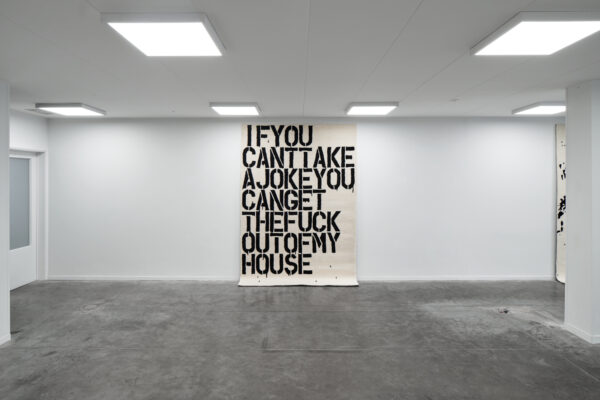
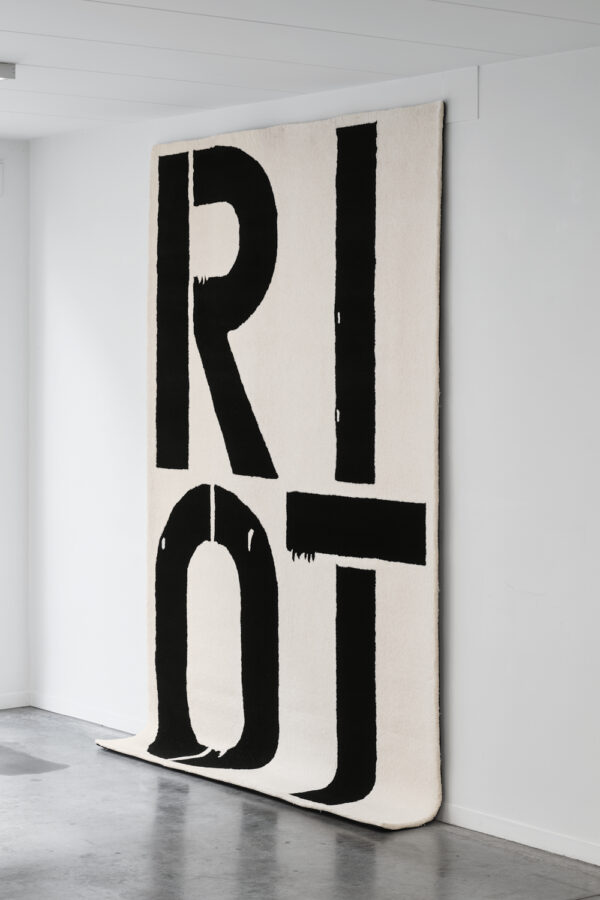
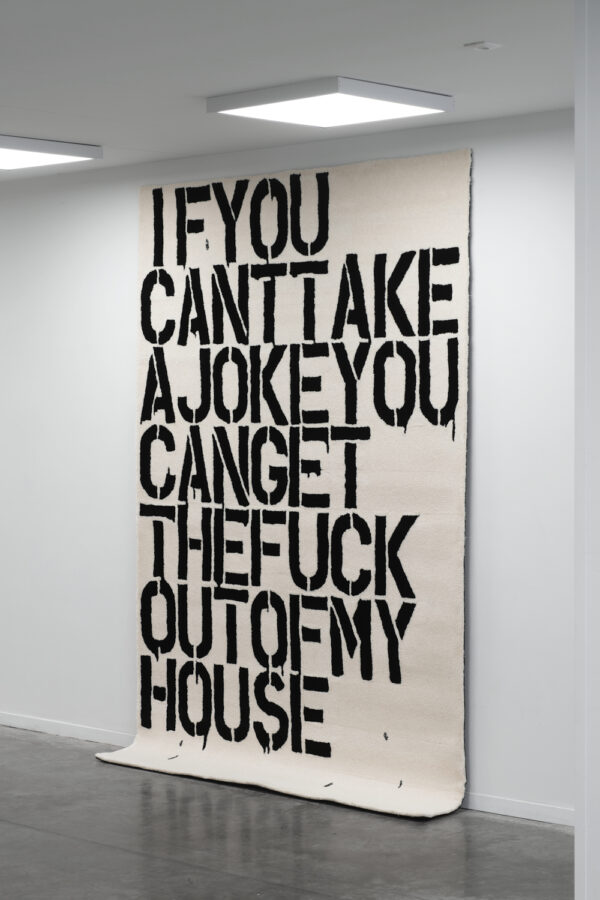
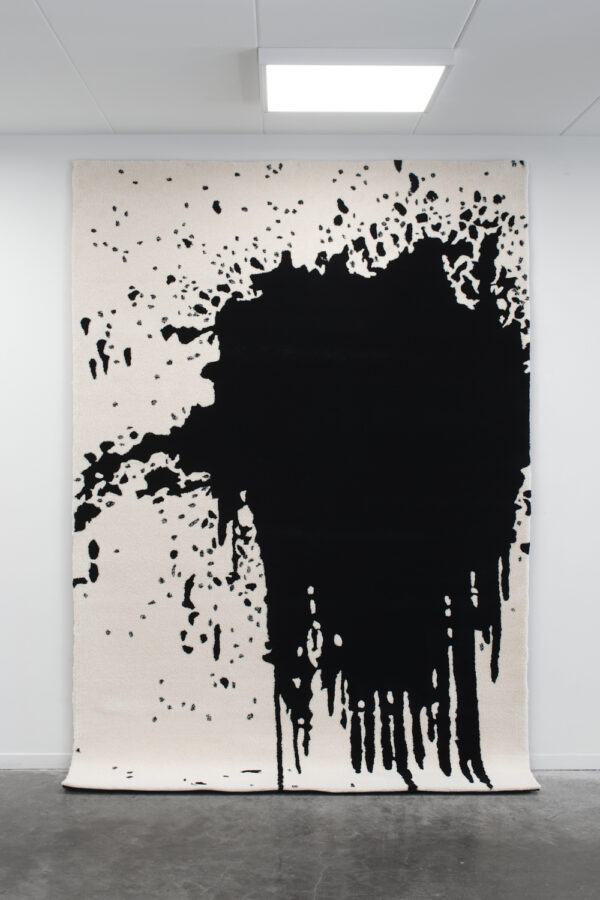
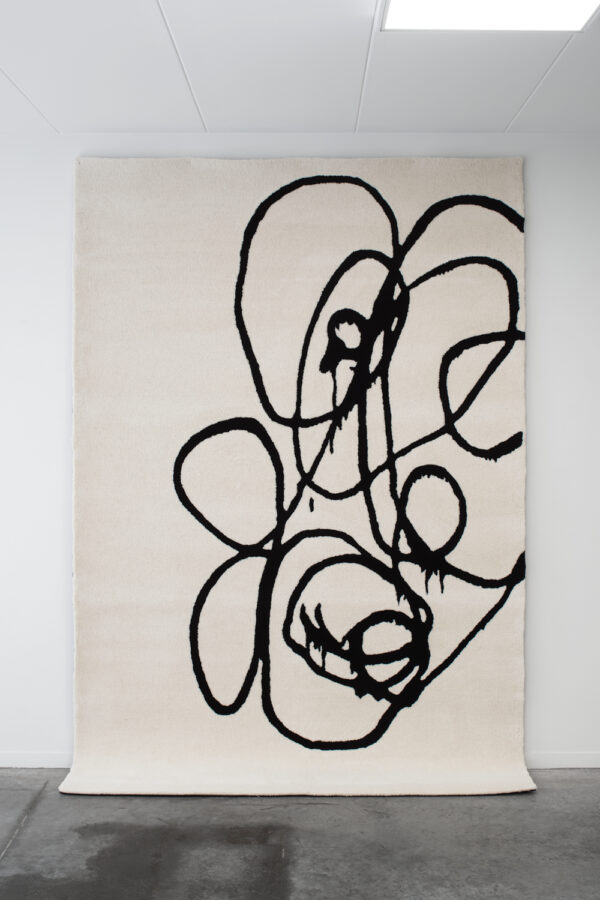
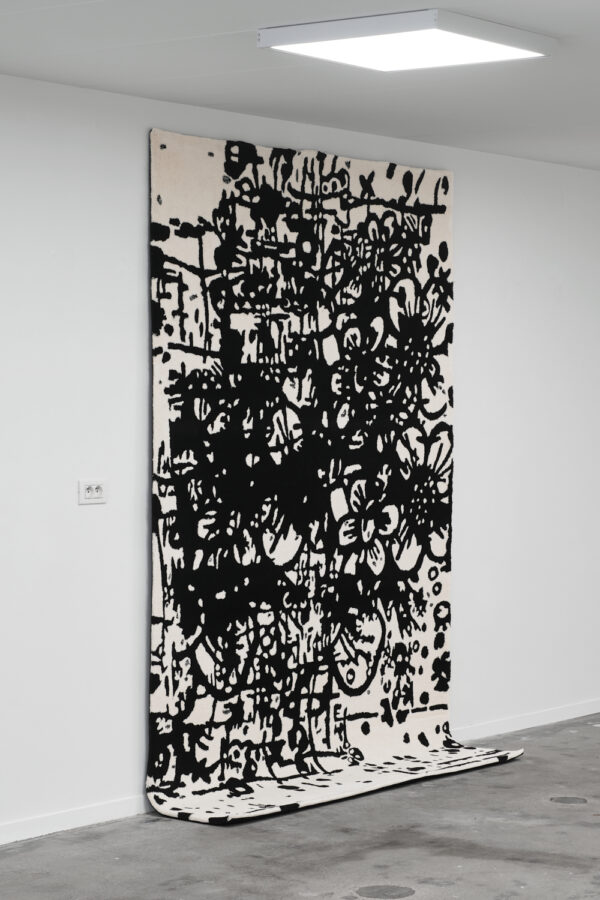
Once inside the exhibition space, we encounter five wool carpets of the same size hanging a few centimetres from the ceiling, sliding gently over the cold concrete floor. These are five works by Van Herreweghe, based on five works by Wool. Although the painting that inspired this series only exists in concept, aside from Wool's famous splashes, Egon also created two other text-based paintings. Untitled (RIOT), 1990 (2025) and If you, 1992 (2025) stand as symbols of Wool's work, strong proclamations that speak loudly to the viewer.
In all pieces shown, black and white wool come together to create a dense perfection — a reproduction whose matrix resembles the 0s and 1s of a computer. Rather than seeking an exact copy of the paintings, the artist finds perfection in the imperfections inherent in the tapestry and fibres. He achieves a kind of perfection by avoiding the exact control that would prevent the pieces from breathing and having their own identity. Within their margin of duplication on the softness of wool, they exist as images of images. They don’t pretend to be the original, while having a similar, albeit different, identity. They are not what they represent, but they represent what they are not.
The works of the Belgian artist establish a dialogue with those of Wool, albeit one that is not reciprocal. Curiously, the first artist has chosen to reproduce these works on tapestry, a discipline that was once important to the Belgian economy but later became minor and almost disappeared. However, in a funny turn of events, it is this discipline's derivative that is now making a comeback, thanks to the internet and the need to fill time and spaces with visual content that may disappear as quickly as it appears. This context plays a role in Egon's technical decision to choose a product that is currently being commodified. However, in a similar way to Wool, who uses splashes and stencil letters in painting, he employs an almost automatic, cold form of production.
Egon Van Herreweghe works within an ambiguous boundary between creation and imitation, recreating and manipulating existing images. Reproducing them with slight differences, he gives them their own identity in order to question certain characteristics and conceptions inherent in them. Whether they are beauty creams (Night Cream Ottoman, 2019), magazine photographs (Vogue Paintings) or contemporary paintings, as he is showing in Kortrijk now, Egon examines the brands and products that are part of our culture to unveil the structures behind them with an ontological twist.
By playing with Wool's work, Van Herreweghe adds another layer of meaning to the pieces, giving them an elegant twist of humour, almost a friendly wink. It is no coincidence that the works reproduced are from one of the most important and sought-after periods in the artist's career.[2] If we consider these paintings beyond the cold and even surface layer of enamel on aluminium, we can wonder where is the dividing line between Wool's art and the product desired by collectors. Or even, what powers and values do we attribute to images, and consequently to works of art?
The wool carpet If you, 1992 (2025), establishes a direct connection between the viewer and the fabric, passing through multiple layers that encapsulate the essence of Wool within a complex system of economical but also symbolic values. The carpet itself contains a subtle and delicate joke, as well as a significant commentary on both contemporary art and Wool's body of work. In a self-referential twist, one could imagine such a tapestry in a collector's home, boldly stating through its wool fibres, “IF YOU CANT TAKE A JOKE GET THE FUCK OF MY HOUSE”. We can wonder what stories would unfold around it, or how it would be perceived.
But as Van Herreweghe would say, “It’s Wool, 100%”.[1] Vernon Silver and James Tarmy. The 350,000 Percent Rise of Christopher Wool's Masterpiece Painting (2014). Bloomberg.[2] Katya Kazakina. Christopher Wool Used to Be the Market’s Most-Wanted Artist. Now, His Auction Sales Have Sunk by 85 Percent. Artnet.
About Miranda Pastor
Miranda Pastor (she/her) is a visual artist, researcher and curator. Having graduated from the Master of Research in Art and Creation programme at the Complutense University of Madrid, she is currently studying Curatorial Studies at KASK & Conservatorium. Her work and research focus on technology and the environment, and she is interested in multidisciplinarity and using images as an alternative means of producing and exploring language. She recently opened F.12, an art space in Brussels, and co-curated An Institution is not an Island.