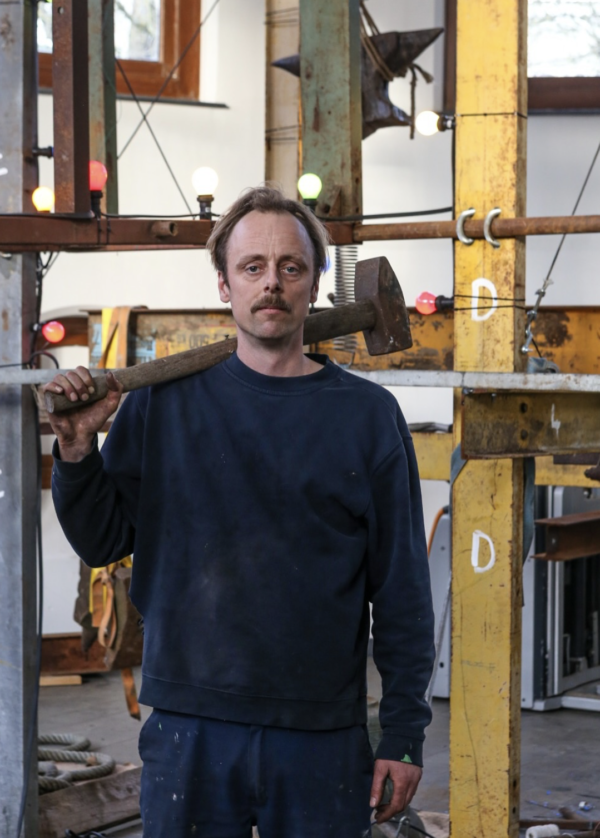
Joost Pauwaert
Cannonballs and Confetti
2026
On the occasion of Joost Pauwaert’s solo exhibition, A Good Hammering, at KIOSK (24.01 – 15.03.2026), the old Anatomical Theatre is being occupied by a monumental kinetic assemblage. Pauwaert’s practice is defined by the construction of large-scale mechanical organisms—utilizing industrial and ballistic elements such as anvils, motors, and cannons—to explore the physical limits of balance and tension. Following the exhibition's opening performance, Alice Zitelli met with the artist at his home in Antwerp to uncover the hidden details of this metal organism, tracing the evolution of his practice and investigating the symbiotic relationship between man and machine.
Alice Zitelli: Entering your exhibition at KIOSK means signing a waiver, accepting earplugs, and bracing for sensory overload. During your performance, you were jumping and pushing these giant mobile structures; a child's motorcycle spinning a carousel on one side, than you placed a cannonball onto some tracks, we watched it streak through the room, whistling past the spectators’ heads to emerge from the back of a carousel donkey before finally rolling into a corner filled with confetti. You seemed to be playing with the machine, acting as one of its gears. What is your relationship with this gigantic installation?
Joost Pauwaert: Well, at first, I planned to activate it on certain days but did not really plan to make myself such a central part of it. That came in the last days before the exhibition. Initially, I used cables and motors, but there was something wrong and the noise was killing every little sound.
Only during the process, I realized I had this feeling that I must physically interact with the machine. I can imagine, of course on another level, a Formula One driver experiences this same unity between man and machine. It is something I discovered by doing, not something I planned in advance, the activation of the installation was exhausting, making myself become one with the machine.
There is a funny, ironic twist to this. Years ago, before I found success as an artist, I worked in factories as an operator. It was heavy manual labor—checking huge machines, and sometimes when something got blocked, you would have to go inside to fix it. I hated that work because I wanted to be an artist. It is ironic that during the performance, I found myself doing exactly that again.
AZ: At first glance, the installation seduces like an amusement park. And it seems deliberately to play on visual deception. It is like entering a circus with colorful lights, balloons, carousels. But then if you focus, you see rotating blades, armors, anvils, objects that require caution. How intentional is this initial seduction that transforms into awareness of danger for the public?
JP: My first works were darker, more purely mechanical, the danger was obvious. There was a moment when I used pink for the first time, I was painting the performance I made A New Study for an End of the World. Homage to Jean Tinguely. The sky was pink. I had never used color like that before. I thought I could not. But once I allowed myself to do it, something opened, not just the color, but the idea that I did not have to restrict myself.
I realized contrast is more powerful. I am fascinated by Napoleonic armies, imagine them marching through streets with musicians and colorful uniforms. People would think, "Wow, this is beautiful!" But it is an army going out to kill soldiers from other armies. You can hold both emotions at once. That is what I want. Even the confetti works a bit like snow; if it snows on the "ugly" parts of your garden, the snow covers it and everything becomes beautiful, bringing it all together.
AZ: Kinetic artworks developed in the 20th century to activate the spectators, to attract their attention. You seem to go beyond that. The spectator is forced to pay attention to this installation because their safety depends on it. On one of the beams, there is an inscription: "Jetzt hast du Schiss?" Is that a direct provocation to the spectator?
JP: Well, it was just a thing in the moment. I was sitting on this beam, and it made me think of when I was growing up in Germany. My father was always this careful guy, whenever I climbed something, he would position himself underneath me, ready to catch me. And apparently, I used to say to him, "Jetzt hast du Schiss?” like, "Dad, are you scared?"
So, I wrote it on the beam. Not as the title of the show or some grand statement, I hid it on the side, almost like a private joke. Maybe, visiting the exhibition he would find it.
AZ: Many visitors, me included, felt as if they had been catapulted into a Looney Tunes episode with giant anvils and rusty springs. You run among them, but unlike Jerry, you cannot be flattened and bounce back to normal as in cartoons. What goes through your head when you perform?
JP: For me, it is about the energy you transmit to the public. Something is really happening. If you go to a theater or a play, they are performing, they are pretending something is happening. But I am not playing. This is actually happening. I am not pretending to jump. I am jumping.
This is what always attracted me, even though art is artificial by name. I do not want to lie to people. This is what people appreciate in my work—that it is real.
AZ: This complex choreography of elements seems to contain years of research because it embraces sculpture, engineering, and history of war, in continuous experimentation. How would you describe your artistic practice and how does A Good Hammering reflect this evolution?
JP: I think a lot of times when you make an artwork, it starts with the space. Is it going to be a sculpture garden, a gallery, a bigger institutional place? When I saw the KIOSK space, I was thinking, where should I start? A lot of my other works were nice at the time, but I felt like they were only a bit of something bigger.
It is a process where I always try to fit new and more things in. It is like a tree that you feed, and it grows, and you are not sure which form it will take.
AZ: It looks like an assemblage in progress. I also notice that you insert elements present in your previous work like the sandwich that you used in the performance Crossfire (2025).
JP: Yes, exactly. Sometimes things become silent pieces, or what used to be in one artwork is not anymore. It is very organic. I sell or throw things away, I keep things in the studio and in the basement, and everything grows and grows. There is a process.
I am reading a book about Rubens' paintings and his sketches1. You have these big-scale paintings, probably executed with ten assistants, and then you have these sketches he made himself; you feel the energy he is putting in. You realize he reused forms, mirrored horses, multiplied figures. He did not invent everything from scratch each time. There is continuity and transformation. I work in an analogous way.
AZ: Your work appears to be based on extremely precise balance of gravity, weight, and tension. To what extent do physics and engineering limit or liberate your creative process? Is it possible to improvise with work like this? Is there space for the unexpected?
JP: Yes, absolutely. That is the fun part. For instance, I lift this chariot with a machine, and suddenly it is up there, appearing to fly. Then I put beams under it and thought, okay, I need something to react to this, so I build a tower. Maybe I marry them together with a bridge. But now this point is heavy, so if I want something to fly, I need to counterbalance it with a heavy wheel. In this way, physics defines the visual reality of the sculpture. Sometimes things do not work. I made a cannonball elevator, but it would have taken too much time, so I canceled it. Now, with the performance, it is perhaps more interesting that I am on the tower throwing these cannonballs myself. It has always worked like this—every mistake becomes something else. This made me understand Calder’s mobiles. He makes something in balance, then he unbalances it, then tries to make it balance again. That game leads to something.
AZ: It seems that you created the installation to occupy the entire space of the anatomical theater, rising to the ceiling, then passing around the back columns on a truck. What was it like to work in this space? I had the sensation that the machine felt a bit constrained and that it almost wanted to escape, to break through the window.
JP: Well, I had a plan to partially open a window and make a structure go outside, but I abandoned it while working. It did not happen. KIOSK is quite an interesting space, a visually dominant space. The heavy window framing in this brownish oak color demands a lot of attention. I solved it by making something that demands even more attention so it can disappear.
I think every talented artist works with boundaries, your own physical boundaries, boundaries put by the institution or government, and you try to go as far as possible without killing yourself. That feeling you describe that the machine wants to conquer other pieces of the building, really transfers to visitors. And yes, I like it.
AZ: I wanted to ask about the noise. It feels like an essential part of the artwork, especially those hammers creating rhythms. How important is the installation sound?
JP: The noise is a huge part of it. It is another sense. Noise is immensely powerful. Music is the one art form that touches us universally; you do not need language. Sound works the same way. If you hear this hammer striking, you understand a lot just from that one sound.
AZ: When the machine is dormant, it is possible to walk around and observe some minute details. I saw the inscription, the beam specifications, the bell. But what struck me most was the hammer wedged between the beams. Is that "the good hammer" from the title?
JP: That is a nice coincidence. The reason is very practical, we were putting this beam on and I was watching, thinking, okay, we need something to wedge in, maybe some wood. Oh, here is a hammer so I put the hammer there. No sane person would put a hammer there, but it works really, nice, so maybe it was always meant to be.
AZ: And what about the bell?
JP: The bell is such a double thing. They were used for serious alarms during war, but also for festivities and funerals. It is something beautiful that can be used in contradictory ways. Furthermore, the bell was very heavy, so I simply used it in its most basic form: as a heavy object.
AZ: Your work is both structurally aggressive and provocative, but also delicate and precise. To quote Tinguely: "For me, the machine is above all an instrument that permits me to be poetic. If you respect the machine, if you enter a game with the machine, then perhaps you can make a truly joyous machine. By joyous, I mean free"2. I wonder if there is also not the desire to set people free, if your art becomes an act of protest that breaks out of the canonical scheme, challenging the institution.
JP: Tinguely is 100 percent right; I would call myself a disciple of his ideas. I believe art should be about making people free, not about things that are too difficult to understand. I do not believe in "elite" art. Sure; it gets better if you study it, but you should not need to study to feel it. Tinguely used to ask museums how many children visited. If there were many, he would be happy. At the opening of A Good Hammering, there was a little kid playing with the cannonballs and hoarding them. It was beautiful. Children are the thermometer; they give you the most honest reading.
Antwerp, 8th February 2026
Alice Zitelli is a researcher and student of the Curatorial Studies program at KASK. Her research focuses on the intersections of exhibition history, curatorship, and the role of perception and participation in kinetic art.
1 Rubens: schilder van schetsen, Museum Boijmans Van Beuningen, 2022. For other books that Joost Pauwaert is re-reading: On the Bookshelf
2 Quoted by Calvin Tomkins. “Beyond the Machine” in The New Yorker, 1962, pp. 44.