Arnaud Rogard
Ik met twee
13.04.24 – 09.06.24
KIOSK and Kunstwerkplaats De Zandberg join forces and are pleased to present Ik met twee, a solo exhibition by Arnaud Rogard.
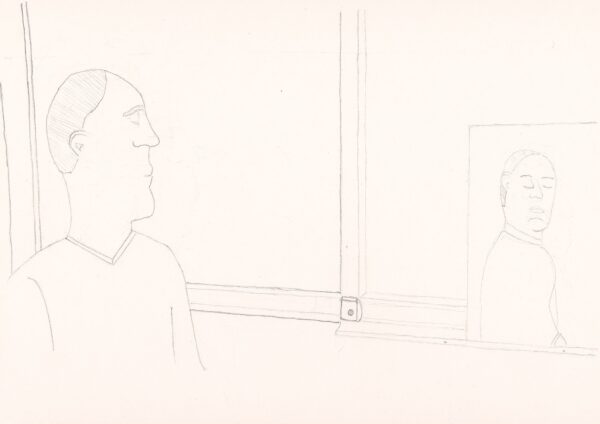
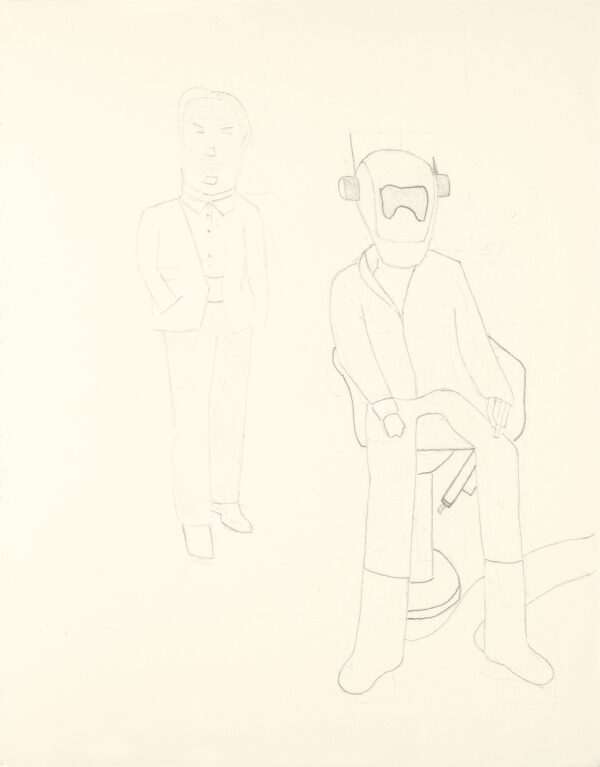
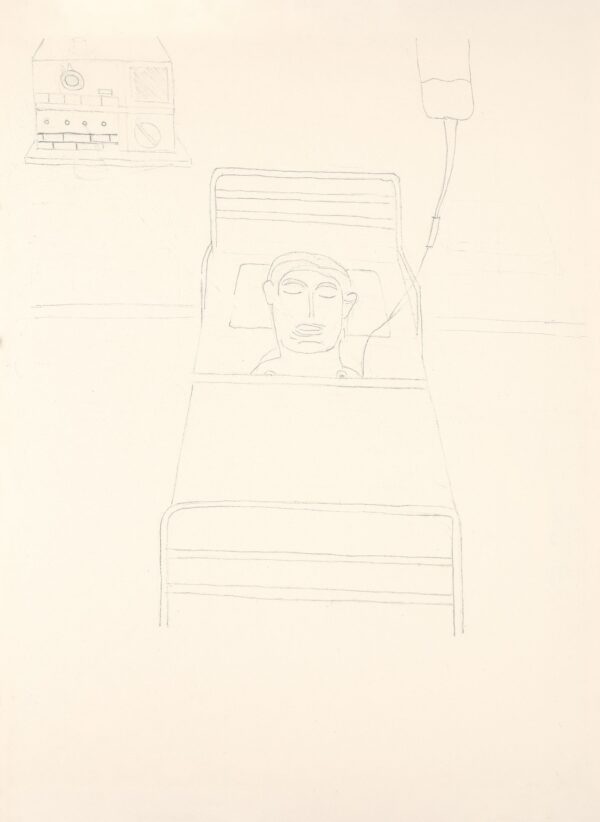
Ik met twee (Me with two) focuses on the pencil-drawn (self-)portraits of Arnaud Rogard. In Rogard’s portraits, drawn over a period of ten years, he uses a consistent line: a line that is determined by the force with which it is put on paper, yet often so subtle that it is almost invisible or even disappears completely. This game of hide and reveal is also reflected in the attitude portrayed. The artist’s gaze is often turned away from the viewer or even completely absent, and at the same time he seems to observe us sideways.
Rogard shows himself in various roles: as an artist at work but also a Star Wars hero, a skeleton, or an authentic backpacking cultural tourist. These personalities arise from his imagination or his personal world, for Rogard is not only an artist but is also active as a dancer and performer. The characters he portrays on stage often also appear in his self-portraits. He reproduces the mise-en-scene from stage to paper in an intriguing manner.
In addition to this display, Arnaud Rogard will be working on a series of new self-portraits for the duration of the exhibition—drawn directly onto the exhibition walls. A series of small-scale architectural works in ceramics will also be presented.
To mark this occasion Posture Editions has published a book of the same name, Ik met twee. The subtlety, simplicity, and power of Rogard’s self-portraits are thus translated into a publication, with contributions from Pierre Muylle and Simon Delobel.
Practical information
- Opening: 13.04.2024, 3 p.m. - 6 p.m.
- Open daily from 12 pm to 6 pm until 09.06.2024
- Free entrance
- Louis Pasteurlaan 2, 9000 Ghent, Belgium
Exhibition text
Whether I would be interested to organise an exhibition with Arnaud Rogard’s work in KIOSK? That was the question I was asked by Dominique Nuyttens and Peter Vanhecke from De Zandberg in Harelbeke, an art studio for people with a disability.
In front of them, on the table of the teachers’ room in the Academy in Ghent, there was a large cardboard portfolio with dozens of Arnaud Rogard’s drawings, as well as a few sketchbooks. As soon as I opened the portfolio, the spell of the images came over me. Drawings of architecture, portraits of people... The works provided direct access to the mental world and the specific interests of this artist, whom I had never met in person. The art lover in me enjoyed the certainty with which each line was drawn on the surface of the paper. A clear line, as the Dutch cartoonist Joost Swarte would call it. But all the same a modest line: some pencil drawings were hardly visible, as if they actually would have preferred to remain invisible.
And perhaps I had some ideas for a book about Rogard’s multi-faceted art practice, which ranges from his ceramic works and on stage acting to his drawings? Arnaud would finance the publication himself. Questions arose straightaway in my mind. How can drawings of various sizes coexist in the same publication, without the larger ones disappearing as they are reduced to the size of the page of a book? Would Arnaud be able to select the works himself? Is it desirable to highlight all aspects of Arnaud’s work in one single volume, as this involves the risk that the book would be the first and last about his work? Wouldn’t it be better to focus on one aspect of Arnaud’s drawings for the exhibition in KIOSK? And ask a publisher such as Posture Editions to participate in the project and publish a less ambitious, but equally well-designed book that would fit perfectly in their series of monographic artist’s books?
A visit to Arnaud’s studio in Harelbeke was helpful to gather an important volume of drawings that were actually self-portraits. During a conversation with members of Arnaud’s family we resolutely decided to follow the same path all professional artists follow to try to get financial support from the Flemish government for a publication. Thanks to the unconditional support from Posture Editions and their positive response to our request to make a book, our application for a grant was approved by the enlightened members of the committee. This made it possible to publish the book that will be launched on the 13th of April.
For someone like me, who is trained as an art historian and consequently also as a researcher, the quest for dates on Arnaud’s drawings or in his sketchbooks generated only frustration. Only occasionally I found a year on the back of the sheets of drawing paper. Even less often, I was able to find titles or texts. Some drawings referred to specific scenes from the stage plays Arnaud had played in. These helped to create a timeline. It remains a question, of course, whether this search for chronology was really relevant and meaningful. Doesn’t the strength of Arnaud Rogard’s self-portraits reside in their simplicity and in the universal recognisability of the situations depicted?
Simon Delobel

Exhibition views: © Isabelle Arthuis