
Veronika Akopyan
Letter from schoolgirl Gerta Grodzianskaya to her mother, 1944
01.10.25 – 31.10.25
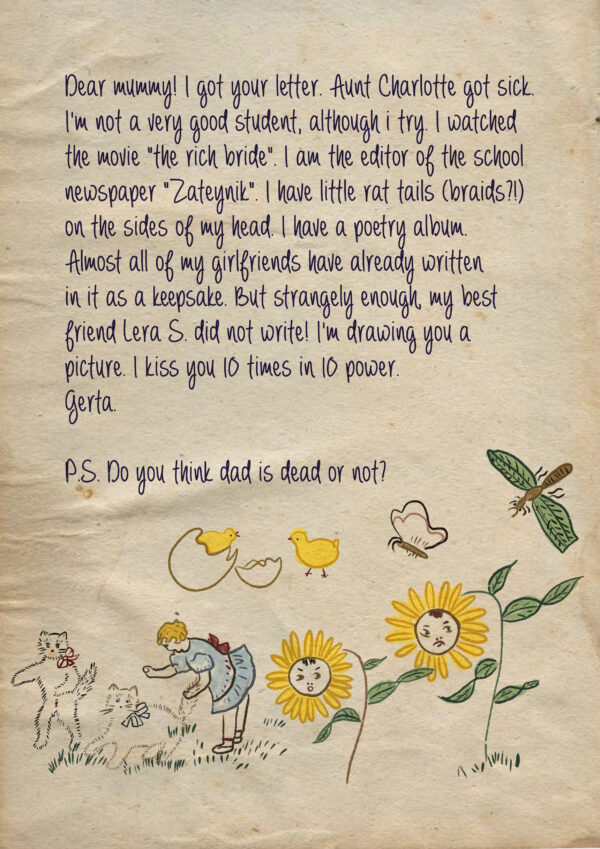
In a letter from Gerta Joelson to her mother, Joelson-Evdokia Sidorovna Grodzianskaya, it becomes clear from the questions she asked that she still believed in the so-called sentence of “ten years without the right to correspond.” This phrase was not an official legal category but an oral formula used by prison and NKVD clerks to indicate that no communication would be possible. Many families interpreted it literally and expected that, after ten years, their loved ones would return. They waited sincerely, clinging to hope.
In reality, Gerta’s father, Evgeny Joelson-Grodziansky, director of the Russian Research Institute of the Refrigeration Industry, had already been executed in 1937—seven years before the letter was written. After the war, when relatives submitted inquiries about missing family members, the NKVD usually provided a standardized response: that the person had “died in the camp.” For many, this vague and final statement was easier to accept than endless uncertainty.
The origins of the phrase can be traced to NKVD Order No. 00515 of 1939, signed by Beria, which mandated that information about the fate of the arrested and convicted be given only orally, without written confirmation. In practice, the words “ten years without the right to correspond” were typically spoken by a clerk through a small window, to the long lines of relatives waiting outside prisons for news of those taken away during the night. In large cities with multiple detention facilities, even determining where someone was being held could take weeks or months. Families made these inquiries repeatedly: if a trial had already been held, correspondence was sometimes possible, but when the answer was “without the right to correspond,” there was nothing left but waiting and the painful hope of reunion after a decade of silence.
The letter Gerta Joelson wrote was addressed to the schoolgirl’s mother, Joelson-Evdokia Sidorovna Grodzianskaya, who herself had been sentenced to eight years in forced labor camps. Little is known about her life and character, but the surviving records establish the following details:
- Date of birth: 1904
-
Date of death: January 9, 1987 (age 84)
-
Place of birth: Zheludyovo village, Kimry district, Tver region, Russia (RSFSR)
-
Place of residence: Moscow, Russia (RSFSR)
-
Address: 98a Bakuninskaya St., Moscow, apt. 1
-
Places of detention and service:
-
Temnikovsky corrective labor camp (TEMlag), Yavas, Mordovia (RSFSR)
-
Segezha ITL (Segezhlag), Karelia (RSFSR)
-
Karaganda corrective labor camp (KARlag), Kazakhstan
-
Akmola camp for wives of “traitors to the Motherland,” 17th special women’s camp division of Karaganda ITL, Kazakhstan
-
-
Date of arrest: 1937
-
Sentence: Special Board of the NKVD of the USSR, under Article 58-6 of the RSFSR Criminal Code, on charges of “member of the family of a traitor to the Motherland” (CHSIR).
*Karlag was one of the largest correctional labor camps in the USSR in 1930-1959.
Sources

About Letters from the Silenced
Letters from the Silenced, a project by Veronika Akopyan, sheds light on activists and political prisoners from the USSR and modern Russia who have faced state repression for their civil and anti-war stances. Inspired by The Return of Names, an annual remembrance organized by the human rights group "Memorial," this project preserves stories of defiance and hope.
Through monthly comics for KIOSK, Akopyan shares powerful biographies and letters, honoring the ongoing struggle for justice and fostering solidarity against oppression.
About Veronika Akopyan
Veronika Akopyan is an illustrator and graphic designer based in Ghent, Belgium. She holds a specialist degree in Graphic Art and Illustration from the Moscow Stroganov Art and Design Academy and a master’s in Graphic Design from KASK School of Arts in Ghent (2023).
Her work, blending storytelling with visual artistry, has been exhibited internationally, from London to Tokyo, and has earned numerous awards. These include the “Image of the Book” awards (2021, 2022), the Grand Prix for Fazil Iskander illustrations (2021), and multiple honors from the American Art Awards. With a passion for storytelling and a fondness for visual expression, she crafts narratives that engage the mind and spark the imagination.

