Ferre Leriche (aka Bleper)
I do badly with happy people
14.09.24 – 10.11.24
This conversation between Ferre Leriche (aka Bleper) and Simon Delobel took place on August 28, 2024 during the preparation of Ferre Leriche's solo exhibition at KIOSK, Nowhere and Back Again (14.09.2024 - 10.11.2024).
SD: Before the summer you moved from Ghent to Lavaveix-les-Mines, a village of about 700 inhabitants in one of the least populated departments in France, Creuse. What was the reason?
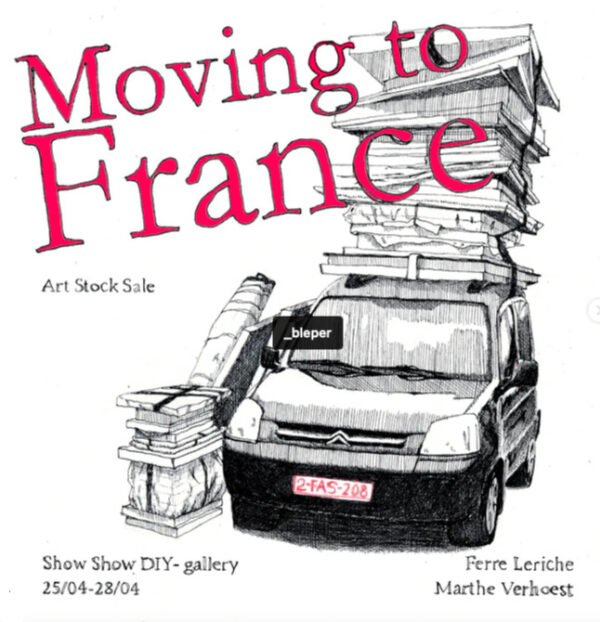
FL: My girlfriend Marthe and I were looking in Belgium for a house where we could each have a studio and an outdoor space. It was impossible to find something within our budget in and around Ghent, especially if it had to be renovated. We visited a place in Portugal, but the forest fires there every year discouraged us. Then a friend sent us a link to a terraced house in France; for less than a tenth of what we would otherwise have had to borrow, we could buy the house we were looking for.
SD: It reminds me of the cartoonist Robert Crumb who moved from the United States to the quiet Sauve area in the south of France around 1990. Did you want to escape something? Or discover something new?
FL: If we had had enough money to buy something in Ghent we would have. But we had also had some tough years in Ghent. For my part, I worked in the social sector, in special youth care, and you see a lot of misery there—a lot of the problems of big cities. When you have tasted the tranquility here, you start to long for it. Also, no stench, no rubbish anywhere, nobody spitting on the street… It is clean, calm, hilly. The food is good. The people are quite friendly. It is all very relaxing. It is a bit like the Shire from The Lord of the Rings. And if there’s not much to do, you cannot spend much money either. The house has been paid off and we only have to worry about putting food on the table. We no longer have to keep a lot of balls in the air to be able to pay for everything. We have much more time for our art practice.
SD: Has the move already had an impact on that practice?
FL: I think it will take a few months before I can fully understand the consequences. It is a moment of reflection about my urban self. I had been very active in Ghent for five years and now I find myself in a place where everything is much calmer. Sometimes I just sit in the evening listening to podcasts, as if listening to the radio in the 1950s…
I also turned thirty and started thinking about my physical condition: now that I live here, I’ve started jogging. But when I get back from running through the fields, I am exhausted and too sweaty to draw. That’s how I started writing. Such an evolution within my artistic practice would never have happened in Ghent. In the exhibition at KIOSK, the texts are read by an AI voice and integrated in a sound work with recordings that I made here in the French countryside.
SD: To finance your move, you and Marthe organized a selling exhibition of your works in Ghent. People could buy original works at very democratic prices. Do you look with suspicion at the way the art world deals with original drawings whose essence is to be reproduced and distributed?
FL: I have a very large production. My drawings are quite intensive to make and I create a lot. Of everyone I know who draws a lot, I am probably still the person who spends the most time drawing. Marthe and I did not plan to take everything to France and we just had drawings in a cupboard. I think that’s a pity—no one has any use for them. It is more valuable when they are viewed by someone… And I make new work anyway!
As for the prices, we found it more interesting if many people could buy work. I understand very well why there are high prices on the art market. It is about pricing, and about determining how many works of an artist come onto the market. And yet I think that’s not the most poetic way to deal with it. Anything that comes after creation is of no importance compared to actually creating art.
SD: Before you left for France, you worked at night in a shelter for the homeless. Do you have a life as an activist in addition to your artistic practice? Or are the two inextricably linked?
FL: I am not an activist, but I do hope to be an active person. Here in our village, one neighbor helps other residents with his brush cutter. There is nothing of how I think about activism about it—they don’t know how Twitter works. I would rather go in that direction.
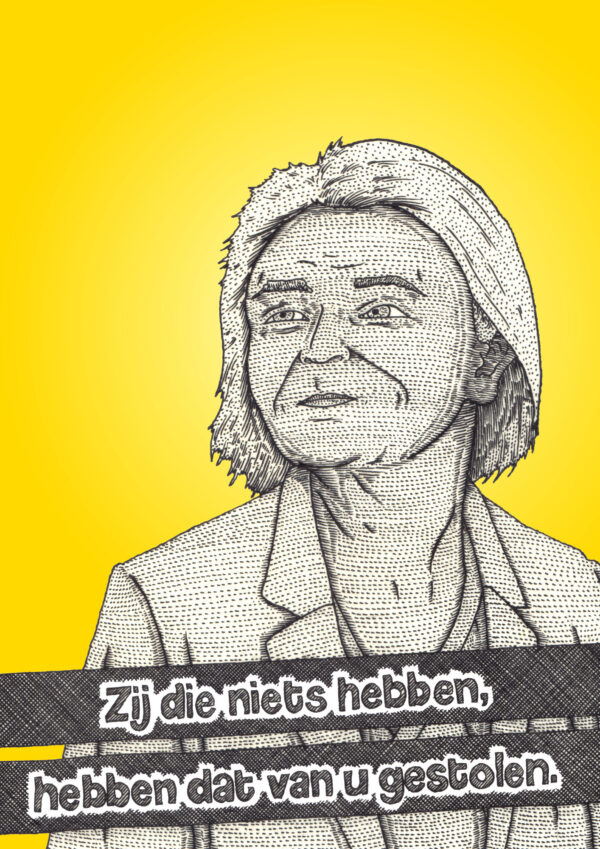
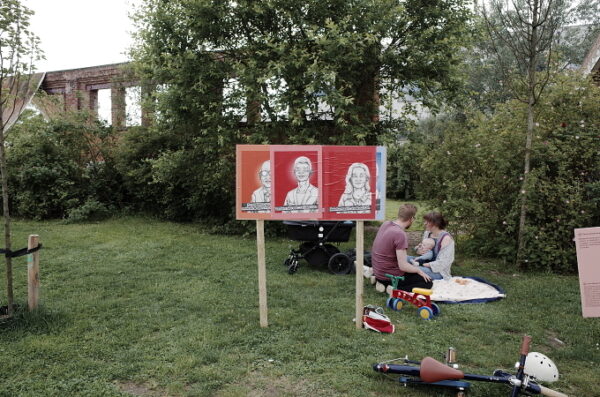
SD: For the Sorry, Not Sorry Festival in Ghent this summer, you made a series of monochrome posters in bright colors that look like election posters. Can art play a role in the political debate?
FL: I hope my work contributes something positive, but I think that’s not often the case. Political posters with satirical inscriptions in the park of Gentbrugge will not change anything. The people who go there are middle-class people looking for culture. They already agree with my ideas. I don’t think artwork will make a big difference, but in the best case it might help some people look at things differently or think.
SD: In an interview with the chatbot MyAI for the Omgeving Celbeton exhibition in Dendermonde last year, you said that in the past you didn’t know whether you were too much of a cartoonist and not enough of an artist, too vulgar or too political. Does that feeling still exist, a year later?
FL: I am still in doubt and the move has caused extra doubt. But it’s fine to have doubts as long as I have food, love, and shelter. For me, drawing is synonymous with mental self-purification. I have a lot of things on my mind, especially with the aggression and other incidents I have seen and experienced in Ghent in recent years. On a personal level, I have certainly had enough of that. But on an artistic level, I am happy to be able to work with that material.
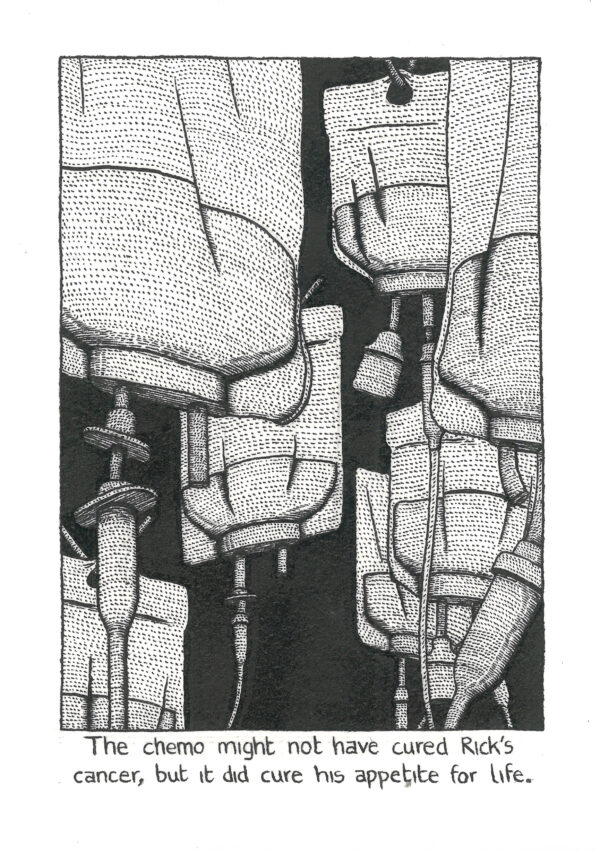
SD: Cancer, bullying, suicide, deceit, violence, racism. These are just a few of the subjects that recur in your work. They are far from trivial and light. And yet every time I discover a new drawing of yours, a smile appears on my face. Can you tell me more about your relationship with humor?
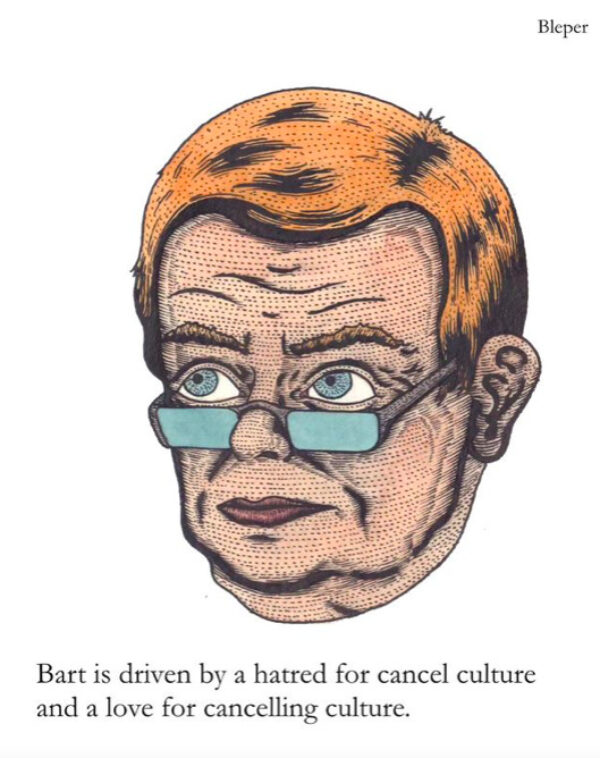
FL: Fundamentally, I think I create humor for the people who need it. Humor is a defense mechanism. I see it during conversations with people who come to buy a drawing from me: I sell jokes about cancer to people who have been confronted with cancer. The same with suicide or euthanasia. With humor, you can get through it. Humor, dark humor, can ensure that life remains livable. Some drawings are satirical. Others parody the world around me. Sometimes there is sarcasm. It’s important to me that I present things differently than you would expect for that theme. There must be an element of surprise.
I make fairly clean drawings. I use cheerful colors. The drawings must have aesthetic value and be visually accessible. But to a certain extent, the drawing is also the candy with which I distract the baby. The text is what brings the hard message...
I do badly with happy people. To enjoy my work, you need a bigger setback than your parents getting divorced. I was once at a zine festival in the Blikfabriek in Antwerp when a woman started leafing through my book, looked at me, and said: “that's sad.” So I don't score well with some people...
SD: You touch on the most sensitive themes in your work and discuss developments such as #metoo and “wokeness.” Do you occasionally subject yourself to self-censorship?
FL: Self-censorship happens automatically because I usually take a very long time to make one drawing. I don't make drawings that are printed the next day and what interests me are works that can still function in ten years' time. So I take my time to avoid saying something vulgar. I had one project, also presented in the exhibition at KIOSK, where I worked completely differently. I gave myself ten minutes to make, scan, and edit a drawing with text. I made about 300 of them. In that case some themes and stereotypes came back a bit more quickly.
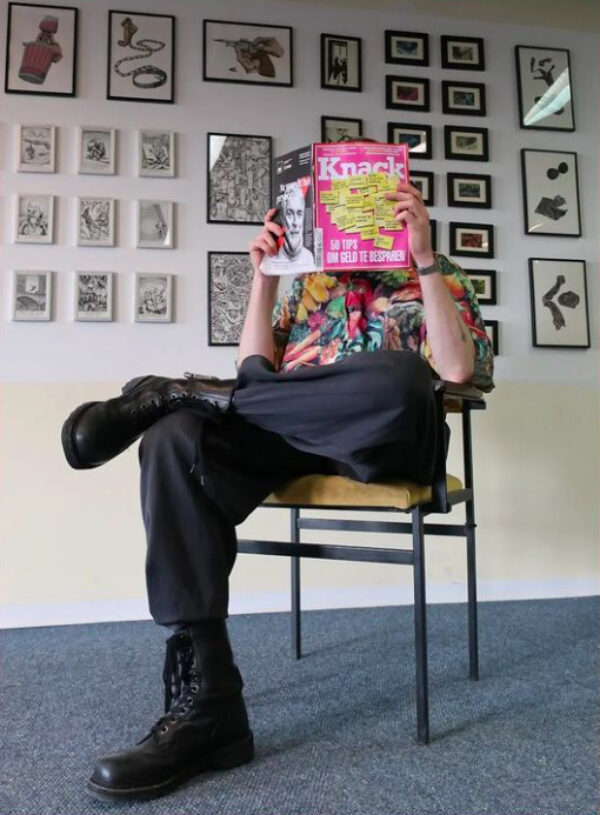
SD: Between February and September 2022, some of your drawings were published weekly in Knack, in the “Het leven volgens bleper” series. Did you have complete freedom there? And how do you look back on that collaboration?
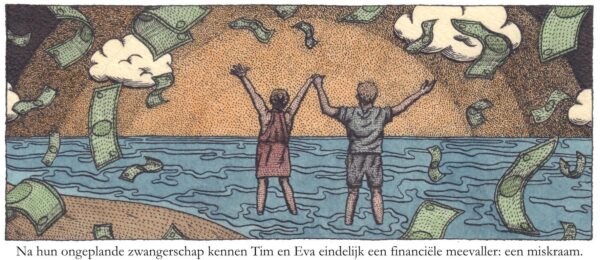
FL: I once made a very romantic image of two people looking at the sea, with the text: “After an unexpected pregnancy, Eva and Tim had a financial windfall, a miscarriage.” The editors called to say they could not publish it, and that was the only time I was censored.
When I got the chance to publish in Knack, it felt like a powerful move and I was quite happy with it. It made the grandparents proud, friends could buy the magazine. But in retrospect, I am left with a series of drawings that cannot be bundled due to their unconventional formats. I would certainly do it again but in a normal format. It was a good learning experience: now I know that I find artistic autonomy much more interesting.
SD: When is a drawing successful?
FL: It is always difficult to evaluate your own work. At the moment of making it, it simply does not work. You’re looking at it for so long that you no longer have the opportunity to be surprised by what you create. The text becomes boring because you have read it so much that the depth disappears. Everything becomes predictable or you start to doubt it… Only after a few weeks, what I call the decay period, can I determine whether a drawing is successful.
I often work with series—of ninety or 130 drawings, for example. That helps me investigate the essence of a theme. For the exhibition at KIOSK, I made catalogues in which I go through my entire work from beginning to end. I was able to discover for myself which elements return or disappear from one series to the next.
SD: You remain faithful to the sheet of paper. What do traditional techniques offer that digital technology does not?
FL: I once did a summer job at Studio100, in a professional setting with the computer. For me it had no magic. The digital image just doesn't squeak enough. I also think that there is no more beautiful sound in the world than that of scratching the paper with my pen. The feeling of the ink with its consistency that glides over the paper. Every now and then there is a hair in your pen and you have an unwanted line. Or a drop of ink falls on the page and the drawing has to be thrown away. When you draw on paper you can't do control+z! You learn to deal with the fatality of a mistake.
SD: Many of your drawings are available on Instagram, but you have distributed some series elsewhere than online, in self-published limited-edition booklets. Is that the result of a desire for independence or simply not meeting the right publisher(s)?
FL: Both, as far as I'm concerned. I've tried a bit of everything. I was contacted by a small publisher in Britain to publish my drawings from the series Too close to the knuckle. Nice people, but when they asked—with good reason—that I make extra drawings, I dropped out. The series was over for me and artistically I didn't feel like making new works.
If you can make a cookbook and earn 2 million euros with it, you might be prepared to make compromises. But for publications like this, where the margins are so small, it's not necessarily necessary. I eventually published the drawings and took them to bookshops in Ghent myself. I did it to see if it worked, and because it's nice to bundle a series and have a final product. But here, such a question doesn't even arise—there's no one here who wants such a book anyway. I will be forced to approach it differently and talk to someone willing to publish the work.
SD: In many of works I notice a form of horror vacui, as if you can't help but put information everywhere.
FL: I’m certainly not a minimalist! I like to give a lot. It just comes from the pleasure of making. You draw and you keep going: “There I can do something! And there!” It comes from a love for what I do. So it’s very difficult to restrain myself.
* Marthe Verhoest. Together with her and Thomas Simon, Ferre Leriche created Galerie Platte Commerce in Ghent in November 2022, and organised several exhibitions with his own work and work by fellow artists (including Ilse Popelier, Sybren Janssens, Caresse Goossens or Seppe De Meyere).