Pieter De Clercq
Eliminate to abstract
14.09.24
In the run-up to the exhibition Elke dag is een tentoonstelling (Every day is an exhibition) by Pieter De Clercq, two interviews took place: one in Pieter De Clercq's studio on July 5, 2024, and one in KIOSK on September 6, 2024.
05.07.2024
SD: Let's begin with the most obvious question. When were you born, and how did you get into art?
PDC: I was born on October 5th, 1976, in Ghent. Both of my parents were active artists in the local art scene of De Pinte—my mother as a painter, and my father as a sculptor. During high school, I had to switch from studying modern languages to a different level. Attending an art school wasn't an option for my parents, so I opted for graphic techniques—a versatile course designed to become a printer, which I had no interest in. I only followed the course because it was the only one offering eight hours of drawing, which was my passion at the time. After high school, when I moved to Ghent, I began visiting exhibitions regularly, mainly in Ghent: SMAK, the Guislain Museum, Galerie Fortlaan, and croxhapox, among others.
SD: What do you consider your first steps as an artist?
PDC: As a child, I frequently rearranged the furniture in my room because I quickly grew bored of things staying in one place. Sometimes, I would change the setting every week. I also played with household items, stacking them on top of each other, constantly searching for the best spot for each object. Things could always be placed better. It was the art of arranging objects! That was it, at least back then. Once I felt the possibilities in my space were exhausted, I would ask my sisters to swap rooms with me. Eventually, I even switched rooms with my parents.
SD: Did you continue doing this after you left your family home as an adult?
PDC: The idea of rearranging things around me never stopped. After my studies, I lived with my two best friends. They knew about my need to move furniture, so they were warned and could handle it. I also started bringing things home from the street and giving them a place in the house, which became a bit more problematic.
SD: How did you eventually decide to pursue an art education?
PDC: I was still drawing and had some ambition, but the pressure to continue studying had faded. By then, I was 27. I hosted a party at home, and someone saw the installations I had created in my house and asked if I was attending the academy. I wasn't. That person had sent his brother to KASK (Royal Academy of Fine Arts) as well. To my surprise, the next morning, he showed up at my door and said, "Aren't we going to enroll you?" It was too late to sign up at Luca, but I could still take an entrance exam at KASK, and that's how it started.
SD: What did you gain from that academic training?
PDC: It helped me immensely. I learned to look at things differently, to be critical, and also to handle criticism. I'm especially grateful that I learned to make molds, something that still influences my practice today. Beyond that, you also learn to develop your own visual language, which for me, has merged with what I've been doing since I was young—arranging household items around me. This is referenced in a section on my website called "punten op uw kotje" (grades on your room). I had received grades for an installation I built in my personal studio at the academy, rather than for the works I had created at the time, which I didn't quite understand back then.
SD: Your studio feels like your living space as well…
PDC: When I'm in the studio, I make it feel homely. And when I'm at home, I want to create art. I think art and life are inseparably connected.
SD: Have collectors or other people asked you to do interventions in their homes?
PDC: I once had an offer to do an intervention in someone's home, but unfortunately, it didn't go through.
SD: Do you have a specific audience in mind when you create art?
PDC: First and foremost, I create for myself. The audience comes later. During the creation process, I don't think about the viewer—that comes during the preparation for an exhibition. But I think it's important to invite people in. I don't shy away from criticism. Anyone is free to say what they want, but there are also limits to how people should interact with my work. For instance, the owner of one of my works once asked if he could paint part of it blue, as it would match his swimming pool better. I told him he could, but then it wouldn't be my work anymore.
SD: Are you trying to achieve something specific with your work?
PDC: Yes, mainly that people shouldn't buy my work just because it matches their pool! (laughs) No, intentions are important. I primarily try to have fun, although it's not always fun—it's still an internal journey. But that journey doesn't necessarily become the theme.
SD: A journey towards what?
PDC: Good question! It's an internal quest, constantly questioning yourself, but also a relentless search for how objects relate to each other and what different emotions they evoke. I hope to present things to an audience differently than they appear in everyday life. Maybe some people will leave with a smile or experience a small change. If that happens, it makes me equally happy. In any case, the goal is never to make people leave feeling bad. (laughs)
SD: How would you define the essence of your practice?
PDC: My work is about erasure—eliminating things. Archiving to erase. Erasing to abstract. The new book with INFINITIF will be an abstraction of archiving.
SD: Does that mean you willingly destroy your works?
PDC: If I feel that certain works no longer align with what I'm doing now, I don't hesitate to dismantle or destroy them, even if they are still good works in my opinion. At one point, I made a lot of assemblages—some were sold, but many have disappeared. I once made 3,000 collages, most of which are physically gone, but I scanned them. This allowed me to move away from the original, creating new possibilities.
SD: Have you written any protocols with instructions on how to present or activate your works in case something happens to you?
PDC: My work doesn't need to live on after I die. By that, I mean all the work that I still possess. I'm not concerned with what happens to it when I'm gone. If I'm dead, the work is dead too. The idea that my work would become more valuable after my death is absurd. People may still appreciate it, and curators or whoever can move the objects or take them to the recycling center. But it will never be the same as when I presented it.
SD: Do you see your works as carriers of your emotions?
PDC: All my emotions are present in my work. They are who I am. Speaking of emotions, in recent years, I've become more sensitive to color. I tend to gravitate toward complementary colors, though I think it's just a phase.
SD: What role does chance play in your practice?
PDC: Chance happens outside the studio, with things I find on the street. You come across something by accident, but you consciously pick it up. If chance enters the studio, it's by letting go—making an unexpected alteration to something I'm attached to. Chance comes from allowing experimentation, so yes, it's present. But how much of chance is really accidental? That's another discussion. (laughs)
SD: Have you already decided what you'll bring to KIOSK?
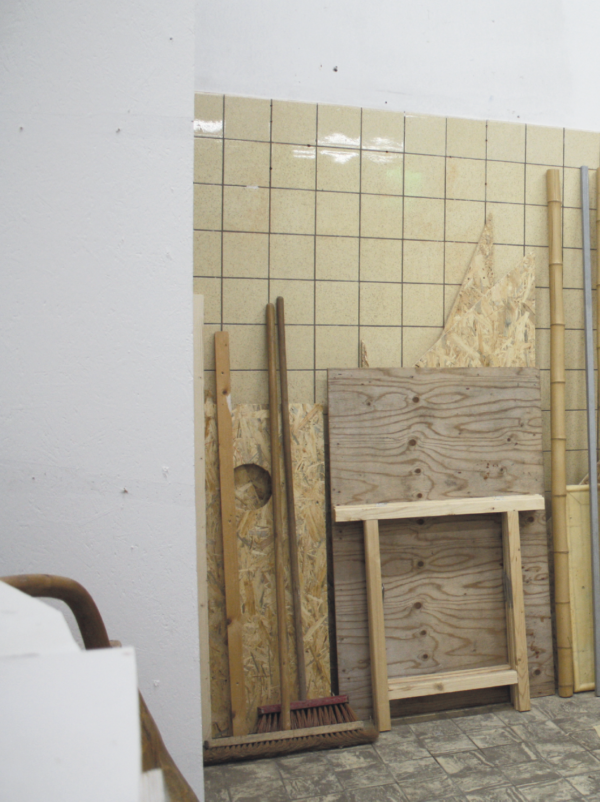
PDC: Mostly castings of wooden branches and logs, as well as some canvases dipped in polyurethane resin, and several household items like my stove, a cabinet, a table, some Aliberti garden chairs, and a few plants with grow lights.
SD: Plants are everywhere in your studio!
PDC: Mostly Swiss cheese plants. And one cactus. They're all exotics. I used to have more, but with all the moving, I had to give some away. The plants you see here are the ones that can survive winter in my studio.
SD: How did plants become part of your life and work?
PDC: Through various circumstances. I once worked for a landscape architect and became friends with someone who had a bamboo nursery. A friend of mine volunteers at a botanical garden and had the largest orchid collection in the country. Did you know that the Kentia palm, which you see here and is now spread all over the world, originally grew in only one place on an island east of Australia? For now, plants have become part of my work—they feature in a recurring series called "Seats for Plants." I once thought it might be a good idea to take a trip to return the plants to where they came from. I wonder if they’d prefer to be there instead of here.
SD: Some people say that plants don’t feel pain because they don’t have a nervous system. I’m more inclined to think we just don’t know how they experience pain yet…
PDC: Yet we already know that trees can communicate with each other, sometimes over long distances, and sense threats.
SD: I see wood in all its forms in your studio—from branches to logs and planks. How do you view that material? Do you see wood as dead or alive?
PDC: They are all objects that were once alive and are now given a new life. They are assigned a new place or places so they can be reactivated. Some of them are cast, which creates duplicates, like they're getting a statue of themselves. All the wooden objects can become characters. Someone has to move them and give them a temporary resting place. I'm convinced they are happy wherever they end up. Their presence compels me to move them.
SD: Are you going to bring fake plants to KIOSK too?
PDC: I once saved a fake plant from the recycling center. It was also a monstera, actually. So, yeah, it’s quite possible it’ll end up among the others.
06.09.2024
SD: Before we talk about your summer stay at KIOSK, I would like to ask about your collaboration with INFINITIF. They published your first artist's book, SUCCES, in 2021…
PDC: … and it was a small success! During the COVID lockdown I built a clandestine café in my studio and Tim Bruggeman and Jelle Martens came there occasionally—I met Tim because he also had a studio in the Lindenlei. They had taken over a publishing house, IMPRIMITIF—in an announcement for an event someone had misspelled it as INFINITIF and they decided to embrace the new name—and I had a collection more or less ready to be published as an artist's publication. The title refers to the “Succes” brand of school notebooks, in which I write down titles for artworks, and the book brings together interventions into my own writing exercises and children's drawings from primary school.
SD: How did the new book come about—the one that is forthcoming INFINITIF and serves as the basis for the project at KIOSK?
PDC: In the archive images of my studio, Tim and Jelle saw material for a new book. The publication collects ten years of photos in my studio, together with a selection of collages and assemblages created during the same period. The three of us made a first selection of 600 of the 6000 images, then we started on a second selection. Tim and Jelle had a precise idea of what type of publication it would be—a kind of IKEA catalogue, a magazine, a publication that could be anywhere, that does not include an overview. Lots of images, no text. Text only on the back. The book offers an insight into an archive, showing what you never see. I hope it will give the public a clearer picture of my practice—in particular the fact that my work is the process itself. It is an ongoing quest.
SD: In mid-July we moved your studio across the water to KIOSK. How did you choose what would come?
PDC: The selection is based on the cast pieces of wood in my studio.
SD: Are there elements that you resolutely did not bring with you?
PDC: My cones with breasts. They are part of a work in public space that I’m working on and unfortunately they weren’t allowed to come with me on residency at KIOSK.
SD: How did you go about working on the installation at KIOSK?
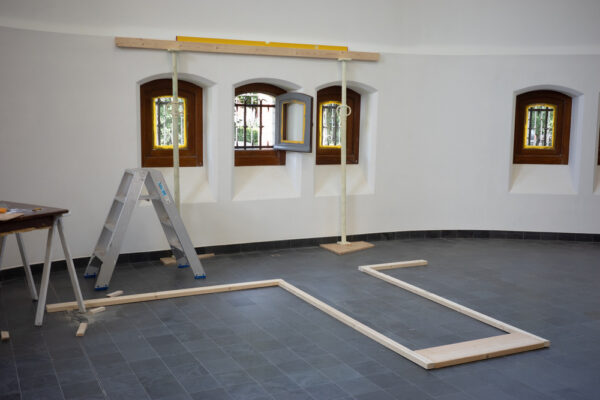
PDC: I never work with a plan or a schedule but I have to start somewhere, often with something that visually disturbs me in the space. Things always arise from an action. At KIOSK I worked alternately on different spaces to distance myself and let things rest in time. The work table has shifted daily.
SD: During the summer you told me that you clean everything every day, at the end of your workday…
PDC: That’s a kind of ritual, yes. It’s also a way to see things with a fresh perspective the next day, when I return. Only when everything is cleaned up do I have the focus to look again. If there’s still clutter I can’t see what’s right or wrong, what needs to go…
SD: For the projects in KIOSK, we communicate with questions. One question you added to the list we sent you was this: “Can sweeping also be a mental cleaning?”
PDC: [Laughs.] Sweeping is also a form of meditation! I believe that. It is a way to end the day and take everything into consideration. My final project here at KASK, for my thesis, was Wikken en vegen (Weighing and Sweeping).
SD: You also asked to add a second question: “Can practicing martial arts make you a better artist?” There’s a sculpture in your studio to do with martial arts. Is there also a work related to it here at KIOSK?
PDC: That practice sculpture is actually in the new book. For the residency I did bring with me a stick (bo).
SD: In the first room, visitors to the exhibition have to choose between left and right. Is there a specific way to get into the total installation?
PDC: I thought about indicating a specific route for a long time, but then it becomes too compelling. What it will do is show itself. It will present the viewer with a choice, everyone will see it in a different way, and they will each create their own path.
SD: What name do you give to what you have created here in KIOSK? An installation? A studio? A Merzbau? It sometimes feels like a labyrinth…
PDC: It’s the sum of things. It is a studio, a residency, and an installation at the same time. It is a place where you can stay… or not.
SD: What do you still have to make? Will you add openings in the wooden walls? Holes play a special role in your work, it seems as if you like to play with the idea of voyeurism. Am I mistaken?
PDC: There will indeed be holes here and there that refer to voyeurism, but that does not apply to all holes... Making circles or holes often means creating problems for which a solution must be found or, conversely, solutions to problems that do not exist. Perhaps that is what typifies the entire residency period that culminated in this exhibition.
SD: Or is making holes a form of mannerism?
PDC: [Laughs.] It can be very pragmatic, for a power outlet for example.
SD: You also wanted to make a connection with the outside world?
PDC: That will come. Three small windows will be openable and the large window on the platform too. It is a different feeling when a window is open from when it’s not. The viewer is lured to the platform via the outer windows to get a view of a different level of the exhibition.
SD: KIOSK is bathed in light. How did you get started with that element?
PDC: Originally I wanted to make a floor across the entire space, so that the ground floor would be dark while the upper floor would be bathed in daylight. But as I said, my work is best when it is not based on a plan. During construction it became clear that some parts of the glass panels had to be darkened and others not. In this way, the building plays a role and the architecture becomes part of the installation.
SD: When we moved your works from your studio to KIOSK, you brought a sound system. Do you plan to do something with sound?
PDC: Whether there will be music at KIOSK is still an open question. When I was in my first year at HISK, during the first Open Studios, I built an installation in my small studio. The visitor had to crawl under my work table to get to a small rest area. I had accidentally discovered music from a label that worked on escapism. I played everything from that label. Then it made sense.
SD: How big is the chance that people will meet you, when it’s not the vernissage?
PDC: Quite big! When I come to water my plants and maybe sweep again [laughs]... During the opening hours of KIOSK in September and October, I will definitely come for a coffee. I might even come and cook again. In any case, it feels like a second home here…
SD: It happens regularly that artists' studios are reconstructed. It always feels like a simulacrum. But everything here is real—you worked here, organized meetings, ate… Are you going to change anything about the installation after 14 September?
PDC: That is not the intention. But it could happen after opening hours, if I start to get annoyed by certain things [laughs]. I don’t know of any other institution that is open every day and that fits with the contents of my book: Every day is an exhibition.