Antoine Meffre Chol
Boy, oh boy!
31.10 – 20.12
Stress
Kids
Two words from a familiar lexical field, as the arrival of a child often comes with its fair share of questions and worries.
Stress Test. On Fathers, Fatherhood, and Fathering, presented at KIOSK from October 31 to December 20, 2026, extends the stress of parenthood to the institution itself. When an artist asked KIOSK to postpone his show to care for his child, the request became a test of institutional flexibility. KIOSK drew on its network to turn the challenge into a group exhibition on fatherhood.
An exhibition on fatherhood in 2026 does not emerge in a vacuum. It follows years of debate around mothers' mental load, gender roles and the presence of motherhood in exhibitions. The unexpected circumstances and a subject of such magnitude inevitably raised my expectations.
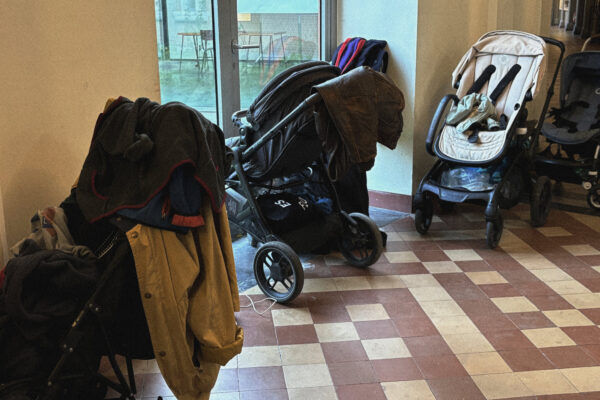
It is a sunny afternoon in Ghent. Approaching the Bijloke, I spot strollers and families. Inside, children play and candies are strewn alongside wine. A good feeling arises. It is quickly challenged. How politely disappointed I am when the first thing I encounter is a painting of a penis by Jacques Lizène. Though the work addresses the valid position of not wanting children, its placement, right at the entrance, feels like an unnecessary provocation. Perhaps intentionally so, it nevertheless seems to reduce fatherhood to its most biological and sexual dimension, setting an oddly reductive tone for an exhibition that promises to explore much broader aspects of parenthood.
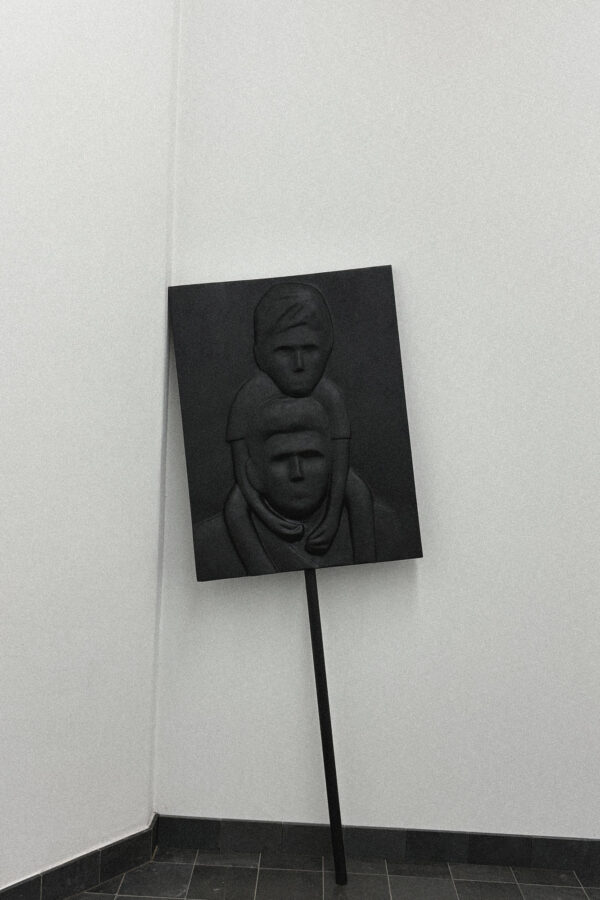
A trio follows at the entrance: Vaast Colson's suspended textile Prairie Pouch (2015), Paul Casaer's all-black placard Daddy's Club (2026), depicting a child on their father's shoulders, and Willem Vermeersch's Leopold II Tunnel (2026), a child's tambourine bearing the king's image. There are worthwhile propositions here, particularly Casaer's use of a childhood image most likely used without his consent in his father's political campaign to depict him as a kid who loves his candidate-daddy. Colson's accompanying text for his “pouch” reads:
“In an age when political correctness has been elevated to the rank of moral compass and affirmative action seeks its vindication in a selective reading of history, I find myself haunted by the peculiar sensation of standing utterly alone on the vast, indifferent prairie, with nothing but my sac.”
Its somehow reactionary tone, seemingly explaining the source of oh-so-contemporary male alienation, feels particularly uncomfortable here, right at the entrance. Alongside the difficulty of engaging with Vermeersch's work without any indication that it is meant to be played, and Lizène's penis painting, it makes for an uneven introduction to the exhibition.
“That was when things went from bad to wurst”*
The next room, with its low presentation and cushions, feels like a children's room. It is where the exhibition's good fathers are given the stage: those who want the best for their children, those who play and draw with them, make cute presents for them. It is nice to see fathers asking how to be good fathers. But what do we learn beyond a father’s self-reflection? The works seem more interested in their self-perception than in the relationship itself.
Laurens Mariën's For Bonnie (2026) is a telling example. The picture book gathers female figures he has selected as role models for his daughter, alongside a text about the project prologued by his journey towards fatherhood. Some passages are strikingly candid, while others come uncomfortably close to familiar narratives of male grievance, framing romantic rejection through self-deprecation and perceived physical inadequacy. The father's emotional journey takes over, and the child tends to appear as a supporting character here. The work also raises separate questions about the role of gender in choosing role models for children. Does a child need same-gender role models, particularly those selected by a parent? Isn't it possible to imagine raising a child simply as a child, regardless of gender?
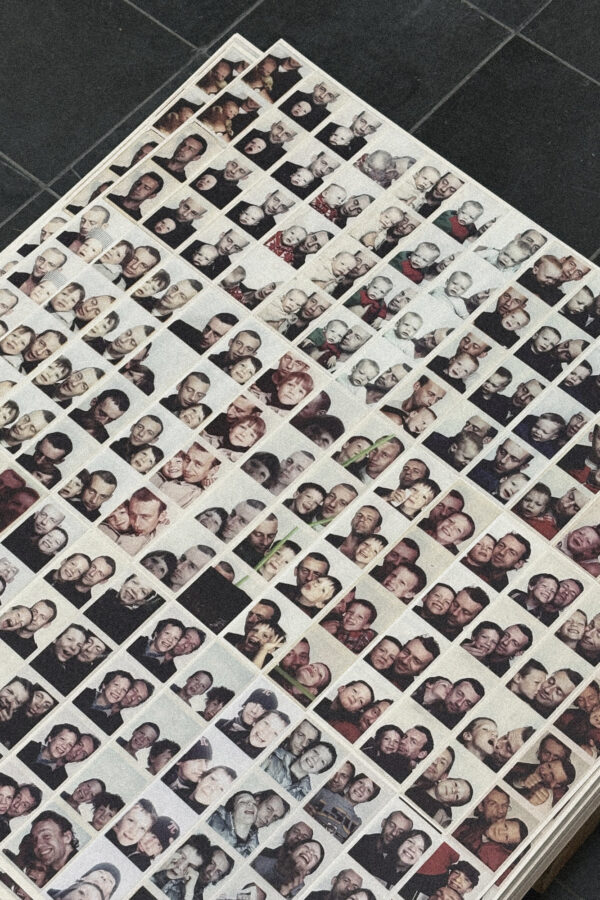
Another version of this one-sided paternal framing appears in Peter Van Hecke's Wapenschild Oskar (2019), Wapenschild Vos (2021) and Wapenschild Nim (2026), coats of arms offered to his children as expressions of who they are to him. Though they are sweet and generous gestures, they nonetheless do frame each child through the father's eyes and interpretation. In Trudo Engels' Auto-Photo (1993–2005), photobooth pictures with his son Cyriel form a sweet parent-child ritual, ending with the announcement that he is going to have a sister. Yet another son is already part of the family, though absent from the photographs. Why, then, does the arrival of a daughter mark the end of this ritual? The mother's pregnant belly is one of the few visual presences of motherhood in the exhibition, raising questions about how maternal and paternal roles are distinguished, and how little space is given to their overlap.
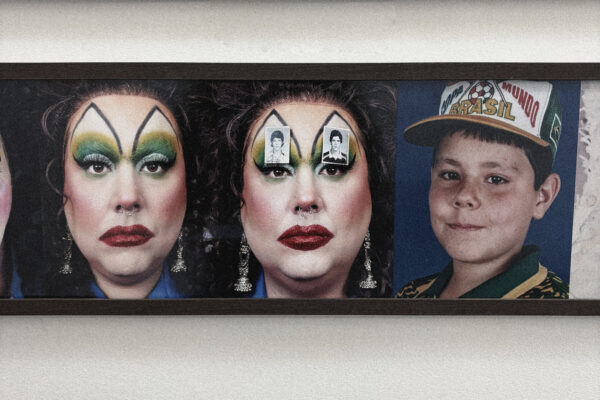
A welcome change of perspective comes in the next room, encountering portraits of a drag queen who seems to belong to an older generation, dressed in work clothes. Danilo Zocatelli's photographic series Dear Father (2024, ongoing) offers an intimate father-son experience, in which a queer child comes to terms with the desire to be loved by their father. The shift from a father’s view of a child to a child's view of a father already seems much more informed. There is something moving in recognizing one's father beyond his (societal) assigned role. Perhaps being a good father does not mean moving heaven and earth to earn a child's admiration; that recognition might as well just come retrospectively.
Quieter approaches to intergenerational attachment appear in Leen Voet's still lifes and Eva Maria Bouillon's video works, alongside the dialogue between a portrait of the late Willy Van Ingelgem, made by his son Herman, and Willy's own self-portrait. This exchange also echoes Ava Pudelek-Hoffman and Nicholas Hoffman's two-handed cadavres exquis seen earlier in the exhibition. These works offer more personal connections with a parent, less concerned with presenting a defined father figure than with gestures and forms of attachment between generations.
The question of what a parent leaves behind, and what a child does with that inheritance, becomes particularly interesting in Sambasiva Rao Patchineelam and Vijai Maia Patchineelam's works. In Samba Shiva: The Photographs of Sambasiva Rao Patchineelam (2017), Vijai Maia brings his father's photographic archive into an institutional framework under his father's own name, the video work Family Album (2018) also turns the family archive into material for reflection. Together, the works raise questions of authorship, recognition and institutional legitimisation. They also happen to be among the (too) few works in the exhibition to bring a non-white perspective into the discussion, and offer one of its more compelling ways of thinking about inheritance beyond the family portrait.
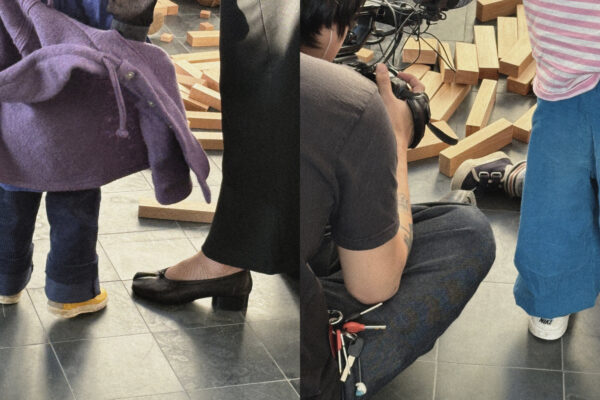
The largest room gathers artists, media and scales in a happy hodgepodge. Felix Kindermann's Stintuition (2026) and associated performance Flex with Paul invite children to play with a wooden-block model of KIOSK's architecture. Their giggles and the sound of the blocks break down the institution's usual formality. Instead of the usual clinking of glasses and polite conversations I am used to hearing at openings, here I am met with the refreshing noise of games and children.
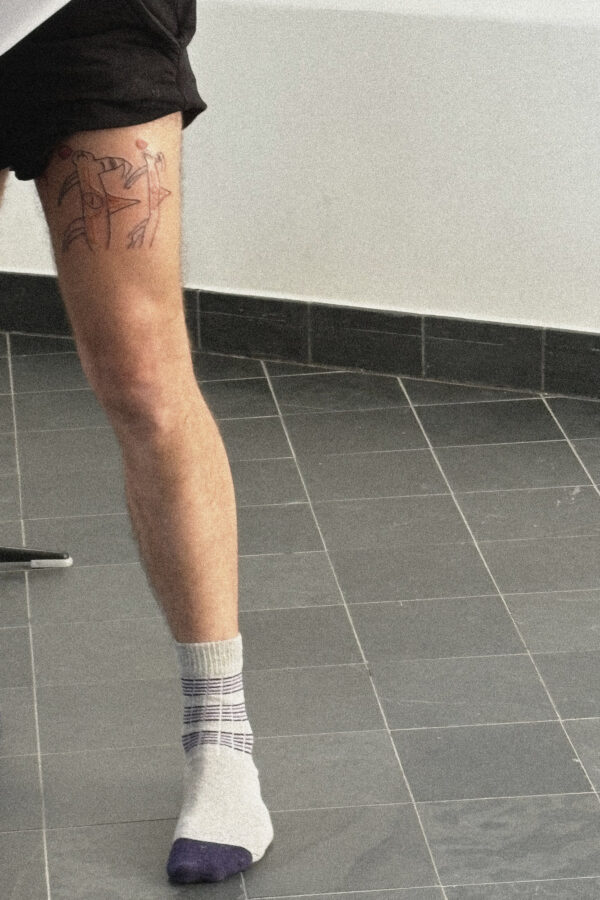
Yet while children fill the room and fathers get their children's drawings live-tattooed, my unease returns. Gunshots can be heard from a distance. No content warning in sight. They come from Yvan Derwéduwé's My Stepfather (2004), in which the artist shoots at a projected image of his stepfather, gradually decaying. Raw testimony of psychological terror, the work sharply contrasts with the exhibition's earlier focus on good fathers, opening up more emotionally charged perspectives from grown-up children. Marthe Merckx's boxing ring Voor mijn liefste, van je oogappel (2026), created for a fighting performance between the artist and human and non-human opponents, also suggests a conflictual relationship with an unnamed paternalistic figure. Even without being activated, the stage of combat is set, the anger is palpable.
“I promise that I will not become an artist”: Trudo Engels's Ik beloof (I Promise) (1972) approaches the father as an obstacle. His artist father repeatedly made him copy this sentence in a discouraging ritual, which Engels later turned into a smart snub. A family friend eventually encouraged him to pursue art: it does take a village, not only parents, for children to find their way. Yet the exhibition text's only explicit invitation is to reproduce the work with a child aged 7 to 9, at no cost. This feels at odds with its core: the repeated sentence has become an artwork, suggesting anyone can make one, but the original exercise was a punishment meant to dissuade Engels from becoming an artist. The invitation risks foregrounding the activity while overlooking its coercive meaning.
Finally, Gerard Herman's PAPA! (2026), heard in the corridor, supposes a parent's buttocks clenching at the sound of a child calling for their dad. A rare acknowledgement of the stress a child's needs can produce, it points to what is largely absent: everyday parenthood. Meals, sleep, illness, interrupted nights, logistics, mental load, fatigue and repetition may not be glamorous or easy to turn into art, but there, a lot of the hard-to-grasp experience of early parenthood is to be found.
What does becoming a father actually change? What happens to one's habits, priorities, time, body, work, relationships and sense of self? The exhibition reflects on the desire to be a good father, but says little about the transformation or the practical and emotional work fatherhood entails.
These questions bring me back to the institutional premise. KIOSK's response to the artist's request is commendable: it shows the strength of a structure able to mobilise its network and adapt quickly. But the gender politics deserved closer examination. Would a woman have felt equally able to ask an institution to postpone her exhibition because of childcare? Would the request have been received in the same way? And would the resulting exhibition have been about motherhood? Parenthood is not experienced equally across genders, and it shows. By placing fatherhood at the center, KIOSK had an opportunity to examine these differences more precisely.
The exhibition brings together a wide range of artists and creates a welcoming, multigenerational space, offering intimacy, play and tenderness as much as discomfort. But this goodwill and the ability to mobilize a network do not, on their own, make a sufficiently developed proposition. The urgency of the response seems to have shaped the show's scope more than its argument. Boy, oh boy, being a good father seems to require more than only wanting to be one.
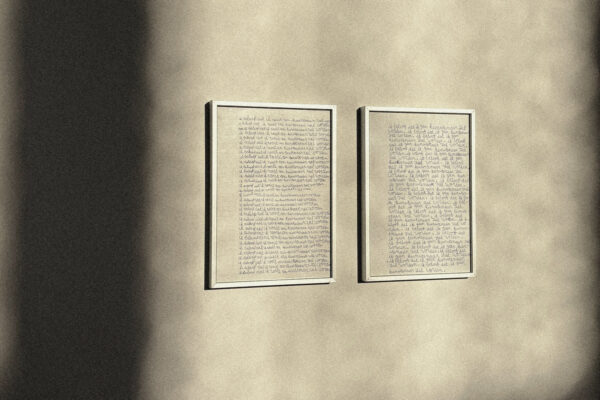
*Julia Schouten's very smart ALLES HAT EIN ENDE, NUR DIE WURST HAT ZWEI* (2026), written and edited for the exhibition, plays with the shaggy-dog tale and the mechanisms of dad jokes. The story directly references Paul Gauguin, who famously left wife and children to pursue his artistic endeavors, an approach inseparable from the highly controversial, exoticist dimensions of his work.
Antoine Meffre Chol
Objects - Curation - Archives - Coordination
Antoine Meffre Chol is a cultural producer working alongside artists and makers. He contributes to the development of creative projects through dialogue, collaboration and skill sharing, supporting original ideas or existing collections.
Born and raised in Provence, a region shaped by historical heritage and territorially rooted traditions, he developed a sensitivity to materials, craftsmanship and vernacular culture. His practice is informed by an interest in the stories, uses and knowledge embedded in objects, from their making and provenance to their place in popular and collective memory.
Initially trained in product design and creative transdisciplinarity, his background spans image-making, production and hybrid projects. His first curatorial project, Revue Occasion, was an independent publication bringing together emerging creative voices around secondhand culture. Through the publication, he developed contexts in which different practices could meet, take shape and reach new audiences.
Following postgraduate studies in Curatorial Studies at KASK School of Arts in Ghent, his curatorial practice explores how collections, objects and overlooked histories can be recontextualized through dialogue with contemporary perspectives.