Washida Meruro
漆の二重性:強固な物質と儚い像
2023
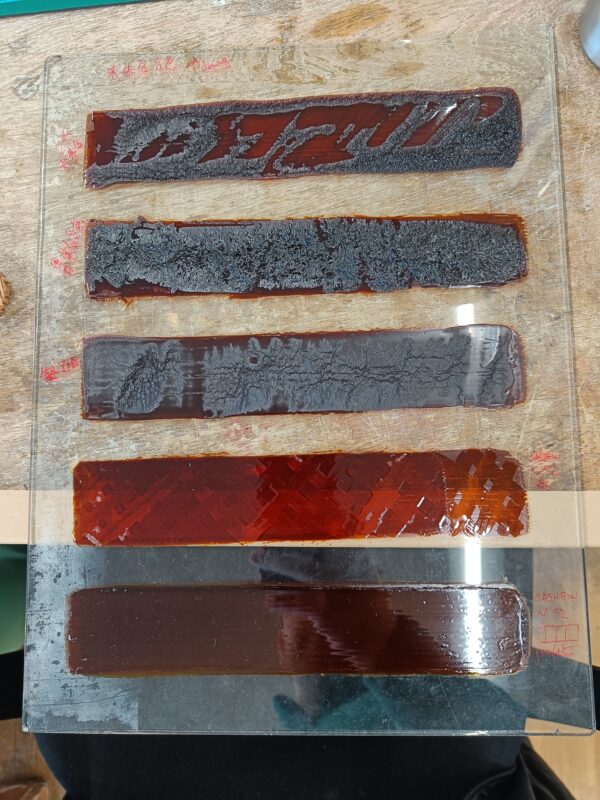
I first saw Mathias Prenen's work more than ten years ago. It was during his residency at Kapo, a small art space in Kanazawa I had helped establish. At that time he was already experimenting with urushi (漆, lacquer) on glass plates, which he mounted and made into slides. The way he bridged urushi to video left a deep impression on me.
Traditionally, urushi has been used to coat and protect. Urushi bowls are made of wood coated with urushi—many layers are applied, making the wood strong and resistant to the elements. Opaque black or red is often used for bowls, but urushi itself is transparent. There is also a technique called shunkei-nuri (春慶塗), which makes use of that transparency to allow the wood grain to show through. But Prenen's act of applying urushi to a glass plate, meant to transmit light, brought out the transparency clearly. The urushi applied to the plate had shrunk due to the nature of urushi itself. The urushi was not only transparent but also formed an image by itself, without need for any artifice on the part of Prenen, the artist.
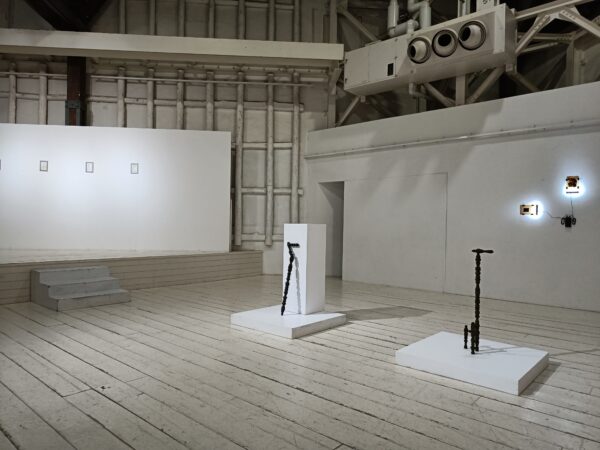
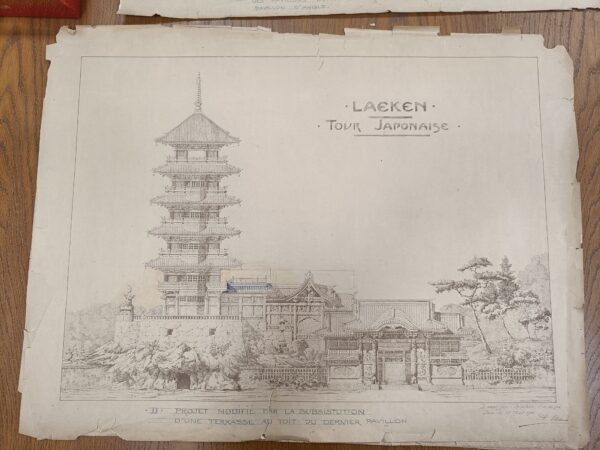
In drawing out the two characteristics of urushi—transparency and shrinkage—Prenen transformed the material into an image. This approach to urushi, evident from the start, manifested in various ways in his solo exhibition at Kanazawa Citizen's Art Center in 2023. It leant toward experimentation rather than finished work: some parts were more like an exhibition of the process. Prenen applied urushi to film to test how it would shrink and painted the surface of a cylindrical glass container with brushstrokes visible, displaying it like a backlit lightbox. Certain works also showed Prenen’s interest in buildings and furniture. For instance, a sculpture like cut-out table legs. The exhibition at the Kanazawa Citizens' Art Center also included a film of a Japanese-style five-storied pagoda built in Brussels in 1904. It mimicked a tower built for the 1900 Paris Exposition. Time-faded color film footage, showing the unrealistic temporary copy with its kitsch Orientalist design, juxtaposed (間・あわい) architecture as substance and ephemeral image. This served as a link between the two strands of Prenen's work: sculpture and projected image.
I think this duality also corresponds to the duality of urushi which Prenen captured, as solid material and fleeting image. For his exhibition at KIOSK, Prenen plans to exhibit his works with urushi for the first time in Europe. I also hear that sculptures and installations developed from the architecture of the venue will also be shown. I imagine that the dual aspect of the urushi works will again be attentively joined with the venue’s architecture and the sculptures.
Born in 1973 in Kyoto, Meruro Washida worked as a curator for 21st Century Museum of Contemporary Art, Kanazawa from 1999 to 2018. He also served as the Japan Pavilion Curator in the 57th Venice Biennale 2017 and the curator of Aichi Triennale 2019. He is currently the curator of Towada Art Center and Associate Professor at the Tokyo University of the Arts. He was guest curator for S.M.A.K. Stedelik Museum voor Actuele Kunst in Gent / Belgium in 2009.
Credits vertaling: Takahiro Kudo / Edited by Jenifer Evans