Veronika Eberhart
Zustand
2025
On the occasion of Veronika Eberhart’s solo exhibition Alles pelt zich, cultural philosopher and writer Kris Pint visited the exhibition at KIOSK and spoke with the artist about her work.
Kris Pint:The exhibition has a remarkable title: Alles pelt zich (‘Everything peels itself’), in Dutch, even though you are an Austrian artist, and the art world's lingua franca is'global English' nowadays. Why this choice?
Veronika Eberhart: For some months now I have been slowly becoming familiar with the Flemish language. As a German speaker, it is tempting to think you understand it, but often it feels like a dream: everything sounds so familiar, yet I don’t fully grasp it. “A dream deme”. It creates space for misunderstandings and mispronunciations, a Zustand I deeply appreciate.
In German, you understand the sentence but might think that zich is a mistake; but then again, when spoken it sounds like alles pelzig (“everything is furry”), the complete opposite of something that is peeled off. I liked these contradictions, as it also reflects the practice in the body of works presented in the exhibition “schälen und überziehen”, “pellen en overtrekken”. And as this is my first solo exhibition in Flanders, I think I wanted to give this occasion a mark in language.
K.P.: How do you interpret the reflexive pronoun in ‘zich pellen’? What is peeling itself? ‘Zich’ implies that it happens on its own, by itself. What role do you, as the artist,
play in this process?
V.E.: I think that no matter how much individuals, families, or societies try to cover up, repress, and avoid talking about their submerged feelings, these will eventually come to the surface. Maybe in different forms, maybe a generation later, but I believe we cannot, and perhaps do not want to, stop it. So, I rather engage with the process instead. That’s why I added the zich, the notion that what is hidden, suppressed or buried may fade from front sight but never entirely disappears; it continues to linger, always ready to re‐emerge.
K.P.: The exhibition takes place in a former didactic anatomical auditorium, where bodies were 'peeled'. This creates a history, but also an architecture, which is very defining for the exhibition space. How did you approach positioning your works within this space—both literally and figuratively?
V.E.: The space carries a dialectical history: on the one hand, there was the literal peeling of bodies, and on the other, it was designed as a disciplinary architecture for observing, dissecting, and understanding from a distance. But what was most striking for me was not only how the gaze is directed through the architecture, but also how the voice is carried within it. The rooms of KIOSK have an extremely long echo, and immediately upon entering, I asked myself: who hears what, and from which point?
That’s why I chose to create a “hidden” sound piece. I built two additional walls at the end of the two corridors; they are not fully closed, but they allow me to extend the exhibition space into two “backstage” rooms. One is used to display the work Love of the Wolf, the other houses my voice with the piece Es bellen die Hunde. It is extraordinary how the spoken word spreads throughout the space, even though it flows quietly from just one corner. The vocals are amplified by the room’s delay, but the clarity of the words fades at the same time.
K.P.: Some works link to Catholic religious imagery, with titles like Repentance, Penance, Devotion, an amulet of Saint Vincent, an empty niche for a statue of the Virgin Mary or a saint... What role does this imagery play in your work? You have previously also designed an altar for a church.
V.E.: You touch upon my biographical background with this question: I was raised strictly Catholic. After breaking with religion for several years, I now find myself returning to its symbolism, which is deeply imprinted in my visual and auditory memory. I simply cannot get rid of it; it always sneaks back to the foreground. There is something extremely haunting about the architecture of religion. At the beginning of this year, I was invited to design and produce the entire liturgical zone for a church in the Austrian countryside. I agreed, firstly because the priest and the community were genuinely receptive to my approach, and secondly because I am deeply familiar with the architectural rituals of Catholic churches, having studied them weekly for years. The visuals are brutal, so adding my own form felt almost like a small catharsis. And, of course, there is the ego involved, because it feels as an artistic honor to contribute to such a manifestation.The acoustics of church architecture share similarities with the KIOSK exhibition space; many are built for voices to wander. I am deeply drawn to architecture that integrates acoustics into its design.
K.P.: Besides Catholicism, there are other layers of narrative to be peeled away: there are fairytale-like elements, politics, and feminism. And there is also your personal history: the woodworking machines come from a family business.
V.E.: There are many layers floating alongside each other, and it’s hard to dissect, but let’s dive in by looking at some concrete works. The Holz Her. I have known the machine since I was a child, growing up in my father’s wood workshop. She was one of the first edge- bending machines in our village, and used first to build beds for an institutional commission, specifically for a boarding school for vocational students. My family took out a loan to buy it. In a village of just 1,000 inhabitants, with a surprisingly large number of woodworkers, they would come from other workshops to my father’s to use the machine; in a way, it soon became something communal, at least in the beginning.
Or consider Prince in Split Werkbank: a matchbox from the ’70s or ’80s that I found in one of the drawers, then placed inside the workbench I cut in half, now standing against the wall with its back exposed. In that context, a “Prince smoker” could evoke a working- class identity: someone practical, tough, socially rooted in labor, yet attentive to small markers of style or habit. Every edge and corner of the machine then becomes an indicator of certain movements, practices, and a broader working-class habitus; little indicators that might evoke associations in the viewer.
K.P.: What is your own relationship with "woodworking"? The craft, but also the
mechanical aspect?
V.E.: The relationship between body, tool, and machine is always layered and charged with tension. Knowledge, power, and risk are embedded in every lever and edge. For some years now, I have been approaching manual work more closely, opening a more intimate and probing relationship with my father’s tools. These tools do not only carry an extremely masculine presence, they also tell a story of craftsmanship, small-scale industrialization, and, for me personally, a history of violence. Yet I have always been deeply attracted to the powder-coated heaviness and the precision of these machines. They are built to last, but the pace of industrial development moved so quickly that they are no longer practical for the speed of contemporary furniture production. That makes them sympathetic.
One of the real joys was using one of the larger machines in the workshop with which I produced the veneer works, such as The R will not be T, Or V, and Love of the Wolf. For years, I watched this huge press move, almost like observing an animal opening its mouth, and now I could finally feed it. Always with a hint of fear, aware that placing the object incorrectly could destroy parts of me, or the work. Perhaps comparable to the Bocca della Verità. You better not lie when putting your hand inside this machine; it could easily crush it to pieces.
K.P.: The scenography is refined, the objects are placed meticulously, there is the beauty of the materials used—the quartz floor slabs, the exposed aggregate concrete, the
bird's eye veneer with its magnificent patterns. What do the formal and aesthetic aspects mean to you?
V.E.: I am tempted to say: beauty lies in the eye of the beholder. But for me, there are always conceptual and structural reasons behind my choice of materials and how I pair them. Personally, I do find Waschbeton (exposed aggregate concrete) beautiful, but it is a harsh kind of beauty, carrying many histories of its use in shaping Western societies. Every material choice is deliberate. The bird’s-eye veneer, for example, fascinates me not only for its intricate, almost hypnotic patterns, but also for the story it carries. These “eyes” in the maple are believed to result from stress, minor injuries, or irregular growth in the tree, almost like a natural record of hardship. What appears as delicate and decorative is actually the tree’s response to adversity. This delicate yet resilient pattern contrasts with the heaviness of steel, creating a tension between fragility and solidity, natural complexity and engineered order.
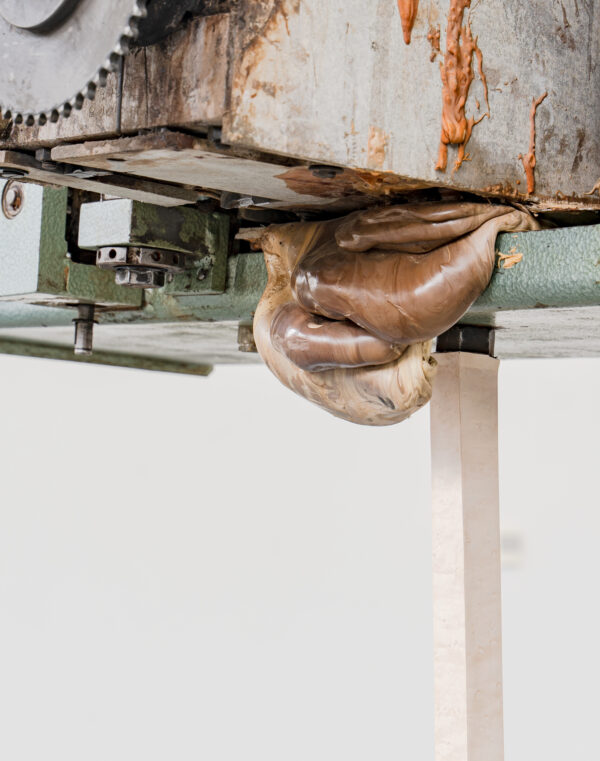
K.P.: At the same time, a sense of menace lurks in many works—the machine, the snake, the axe. The formal purity is often contrasted with the amorphous, even the abject. A lump of glue bulging from the machine like an intestine, old layers of lacquer, weathered wood, rust... it gives the impression of 'controlled violence': the calm before, or after, a storm. Much seems to remain unsaid, unconscious, concealed, held back, which creates a tension within the constellation of works. How do you see this?
V.E.: If the works already transported this for you, I am glad. Does Martin Heidegger kill Hannah Arendt with an axe in Elfriede Jelinek’s Totenauberg, or does Elfriede Jelinek use her words like an axe to kill Martin Heidegger? I am still wondering.
K.P.: The violence is also present in your interventions as an artist—you take machines and tools apart, saw through table legs, suggest the swinging motion of an axe, place an aggressive black wedge into a flat, pale veneer...
V.E.: There is a fascination in splitting and cutting open working tools, revealing an inner history; examining the mechanics of materials. I am not entirely sure, though, what I am searching for.
I only recently heard Anne Carson reflecting on how Gordon Matta-Clark’s twin brother was schizophrenic, and she was asking whether the shifting in and out of consciousness of a close relative may have made one particularly sensitive to holes, splits, and disruptions. A thin edge appears where no edge had previously been conceptualized. I could relate to this. Growing up I witnessed it at close range. I learned early to listen carefully to every step, every crack, to look beyond the surface meaning of sentences, understanding that authenticity simply does not exist. Since there was no way to fully make sense of my father’s presence, I turned to the tools he built and worked with. At the same time, these tools are witnesses themselves to certain generations, touched endlessly by many hands.
The altering brings me satisfaction. Each intervention is analytical, a semiotic probe. Not to create beauty, but to gather information. Let me borrow the words of Anne Carson again when she writes about living with a father who has dementia: “To live with a mad person requires many small acts of genius — reverse of the moment when Hellen Keller shouts 'Water!' — when you glance into the mad world and suddenly see how it works. My mother got good at this. I did not. I became interested in penance.”
K.P.: Besides being an artist, you are also a member of a punk band and a researcher at Hasselt University. How do these roles relate to one another? Are they seeking the same thing, just via different paths? How do they relate to each other?
V.E.: All of this is me, none of this is.
November 2025
Kris Pint teaches cultural theory at the Faculty of Architecture and Arts at Hasselt University. His research focuses on how literature, (interior) architecture and visual arts help propose alternative forms of living, dwelling, and knowing. He also examines how creative (non-) fiction can be used in artistic research. He is the author of The Perverse Art of Reading (2010), De wilde tuin van de verbeelding. Zelfzorg als vrolijke wetenschap (2017), Meteorologie van het innerlijk (2020) and De extase van de jagers (2024).