Anne Rosa Lut
An exercise in connection and separation #5
08.03.25
An exercise in connection and separation#5 is een performance van Anne Rosa Lut, waarin zij de ruimte tussen mensen probeert te begrijpen. Met blauwe lijnen verdeelt ze de ruimte en het publiek om te onderzoeken hoe het voelt om van elkaar gescheiden te zijn. De lijnen maken de afstand tussen ons zichtbaar en markeren het punt waar het ene eindigt en het andere begint. Maar kunnen deze lijnen ook een plek van verlangen zijn—een grens die nieuwsgierigheid en hunkering oproept naar wat zich aan de andere kant bevindt?
Als pre-masterstudent Autonome Vormgeving onderzoekt Anne Rosa Lut (zij/haar) grenzen als mogelijke ontmoetingsplekken. Door de grens tussen België en haar geboorteland Nederland te bezoeken en vast te leggen, verkent ze hoe het is om precies op de scheidslijn tussen twee culturen te staan. Recente politieke ontwikkelingen maken het steeds urgenter om deze ruimte niet alleen te zien als een scheiding, maar juist als een plek waar twee werelden samenkomen. Dit is precies wat Anne Rosa in haar werk probeert te verkennen.
Dear M,
I’ve been consulting a map. I’m trying to get a grasp on the distance between us. My fingers are tracing the space in-between, to get from here to there.
You know, if your plane went in a straight line to get to its destination, your body will have crossed three national borders. Four if you passed the Vatican. Did you notice these crossings?Remember when I told you that borders are blue? On the map that I’m looking at, they’re black. But I think they only did that so we don’t confuse them with rivers.
Do you know why the sky is blue? When sunlight reaches our atmosphere, it scatters, like a glass slipping from a hand and falling on a stone floor. Blue light scatters more than other colors. Glass flying through the kitchen. Blue breaking apart, separating, creating distance.
Blue is the color of distance. Blue is the in-between. Blue is that you are there and I am here. Blue is desire. Blue is wanting something that is out of reach. Blue is the color of isolation, of separation. That’s why borders are blue.
If your plane went in a straight line to get to its destination, your body will have crossed three national borders. (you know) Defining a nation’s territory is not their only function. In reality those lines on that map are doing much more than that. Those lines separate. Those lines can increase the distance between two people. They might be in arm’s reach but that invisible line will make it impossible for them to touch. Simply because they were born in between the wrong set of lines. Meanwhile, you probably didn’t have any issue getting on an airplane and crossing three of those borders. You probably didn’t even notice.
When you return, I will draw a blue line around you. To make visible the distance between us, even when you are within arm’s reach. My blue is a blue of desire. Because you’ve always been a mystery to me. Maybe we’ll find each other one day. In the scattering of blue light.
All my longing,
R

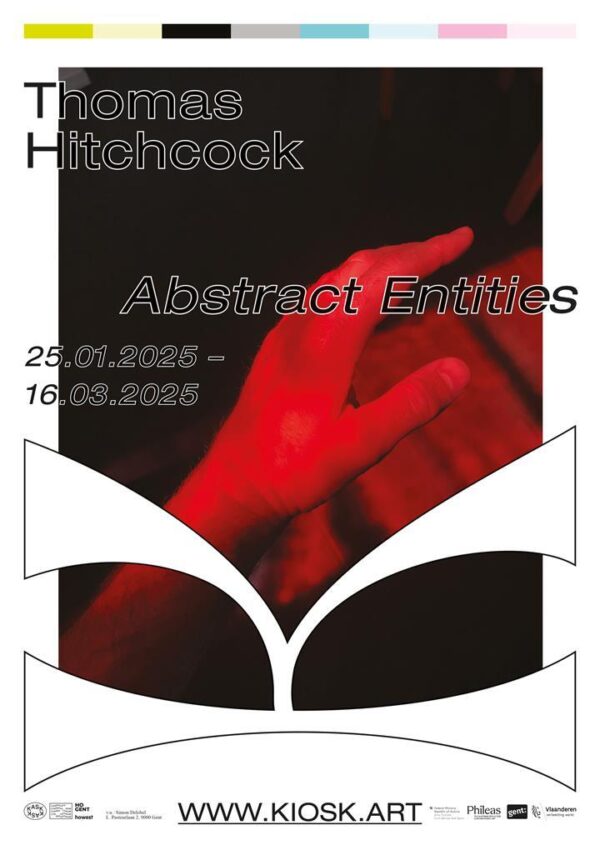
Abstract Entities, Thomas Hitchcock's eerste institutionele solotentoonstelling in België verkent de kruispunten van de Art Nouveau en de culturele periode van Europa's fin de siècle, in combinatie met hedendaagse technologische ontwikkelingen. Tegen de achtergrond van de huidige mondiale kapitalisme en digitale verschuivingen, onderzoekt en contrasteert hij kritisch thema's van uitbuiting binnen een bredere beweging van terugtrekken in innerlijkheid en droomachtige sferen.
Hitchcock's nieuw gecreëerde sculpturale installatie, in het voormalige anatomische theater van KIOSK, fungeert ook als een open platform voor tijdelijke interventies door Belgische kunststudenten. Gedurende de tentoonstellingsperiode zullen er verschillende interventies plaatsvinden in diverse media, waaronder performances, muziek, collectieve lezingen, gesprekken, workshops, discussies, lichaamspraktijken, poëzie en vertoningen – te beginnen met de eerste bijdragen tijdens de opening
Deze tentoonstelling werd geproduceerd in samenwerking met Phileas - The Austrian Office for Contemporary Art, en met de steun van het Federale Ministerie voor Kunst, Cultuur, de Ambtenarij en Sport (BMKOES) van Oostenrijk.